The Leverage of Live: Sports Broadcasting Rights in 2026
Four days remain until the FIFA World Cup 2026 kicks off across North America. The financial machinery behind your screen is moving at a record pace. The sports broadcasting rights 2026 cycle has fundamentally altered how fans in India and across the globe consume live matches. Broadcasters are no longer just buying airtime. They are purchasing data-rich ecosystems. This shift from traditional cable to hyper-personalized digital platforms has created a high-demand environment for those who understand both the technology and the commerce of play.
Wealth in the modern sports economy is built on assets that earn while you sleep. In this industry, those assets are broadcasting rights. The internet has moved the marginal cost of distribution to zero, yet the cost of live attention is higher than ever. If you want to build a career in sports, understand this: media rights are the sun around which all other revenue orbits. We are seeing a transition where judgment and technical literacy in media planning are the most valuable forms of specific knowledge.
You will learn about the current valuation of global rights, the dominance of Indian OTT platforms, and the specific skills needed to enter the sports media sector this year. This isn’t about watching games. It is about managing the pipes that deliver them to billions.
The State of the Game: India’s Media Rights Market
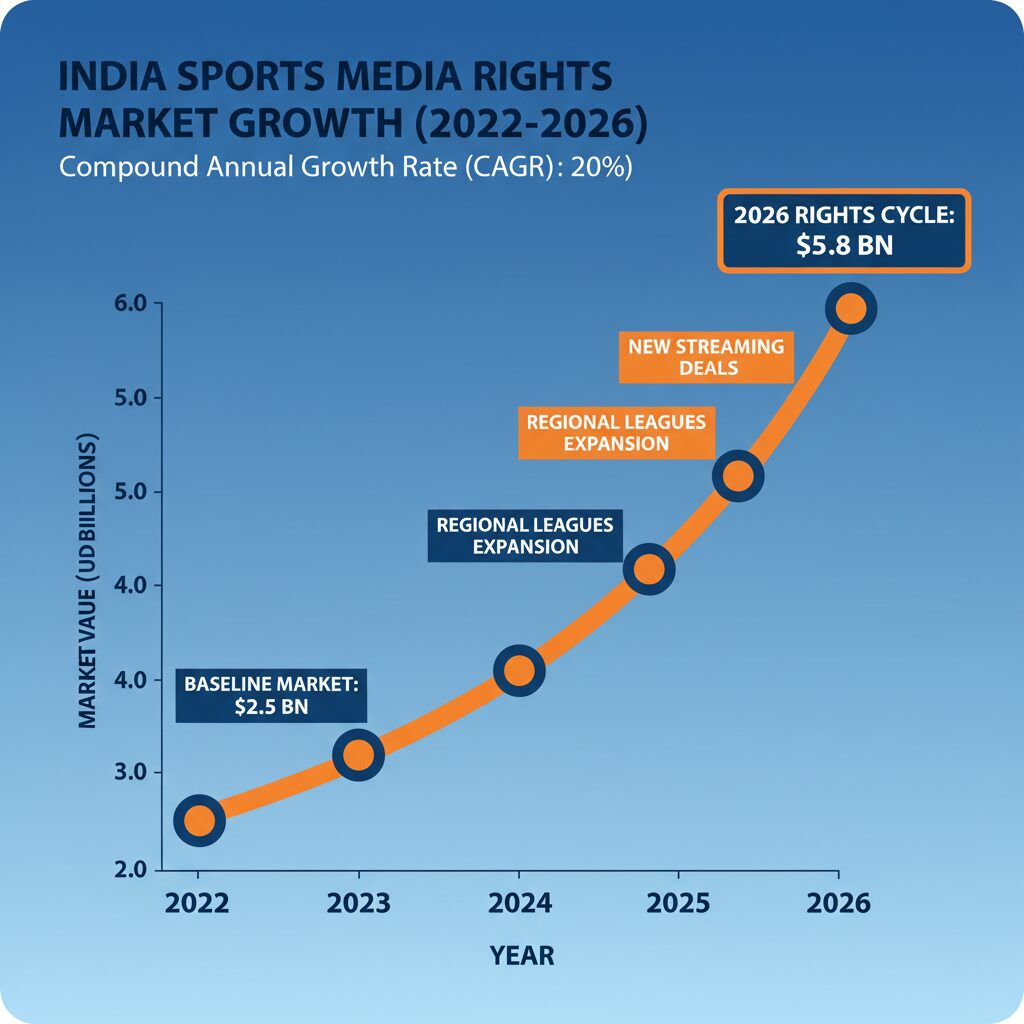
India is the most contested media market on the planet in 2026. The sports media rights market here has decoupled from global trends because of mobile-first consumption. While Western markets struggle with aging audiences on linear TV, India’s youth demographic is pushing rights valuations to levels that seemed impossible five years ago.
The Duopoly: Viacom18 and Disney Star in 2026
In the current June 2026 cycle, the duopoly of Viacom18 and Disney Star defines the market. They are not just broadcasters. They are data aggregators. By securing the sports broadcasting rights 2026 for major properties, these giants have built moats around their digital ecosystems. They use live sports as a loss leader to acquire users for their broader entertainment and commerce offerings.
When you analyze the IPL vs Premier League revenue, the growth trajectory is clear. Viacom18 has successfully integrated its streaming platform with a unified interface that offers real-time stats and e-commerce. This is the leverage of the modern era. They are capturing the entire value chain from the moment a fan logs in to the moment they purchase a jersey. This requires a sophisticated understanding of salary of sports manager in IPL 2026 roles. Media planning is no longer a support function; it is a core competency.
Regional Feeds: The New Scale
Regionalization is where the real scale lives. Broadcasters discovered that English and Hindi are just the tip of the iceberg. In 2026, providing feeds in Tamil, Telugu, Kannada, and Bengali is a requirement, not an option. This localized approach has increased the total addressable market by nearly 40% compared to previous cycles.
Advertisers pay a premium for regional slots because engagement is deeper. A fan watching a game in their mother tongue stays on the platform 25% longer than one watching a generic feed. This creates a massive need for sports managers who can coordinate multilingual production teams and regional ad-sales strategies. The value is no longer in the broad reach. It is in the depth of the connection.
The Billion-Dollar Jump: FIFA Revenue 2026
FIFA is on track to shatter its financial records this month. The 2026 edition is the first with 48 teams. That means more matches, more inventory, and more rights to sell. This expansion is a masterclass in scaling an asset without diluting the brand.
Breaking Down the ₹90,000 Crore ($11 Billion) Target
According to FIFA’s 2026 financial projections, the organization is targeting total revenue of ₹90,000 crore for the 2023–2026 cycle. This represents a massive jump from the Qatar cycle. Most of this growth comes directly from sports broadcasting rights 2026 and expanded sponsorship tiers. The North American market—USA, Canada, and Mexico—has provided a massive boost in local commercial interest. Meanwhile, the Asian market continues to provide the highest viewership numbers.
For a professional in India, this ₹90,000 crore figure represents opportunity. Managing these funds requires expertise in FIFA World Cup 2026 logistics and financial oversight. The revenue is not just a number. It is a signal of the industry’s health and the increasing complexity of international sports contracts.
How North American Time Zones Dictate Indian Ad-Rates
Time zones are the silent arbiter of value. With the World Cup hosted in North America, many matches kick off late at night or in the early morning for Indian viewers. This has forced a shift in ad-buying behavior. Prime-time slots are no longer the only game in town.
Advertisers are now focusing on ‘catch-up’ rights and short-form highlights packages. The value of a 30-second live spot at 3:00 AM IST is lower than a 6:00 PM spot, but the value of the digital highlight clip that goes viral at 8:00 AM IST is skyrocketing. This means the money is moving from the live broadcast to the “on-demand” window. Understanding this nuance is essential for anyone pursuing a Masters Programme in Sports Sciences or management. Data analytics now dictates where the money flows.
OTT Streaming: The Death of Passive Viewing
Linear TV is a luxury of the past. OTT is the present. The current season shows that fans want more than a one-way broadcast. They want an experience they can control.
Interactive 4K and Real-Time Betting
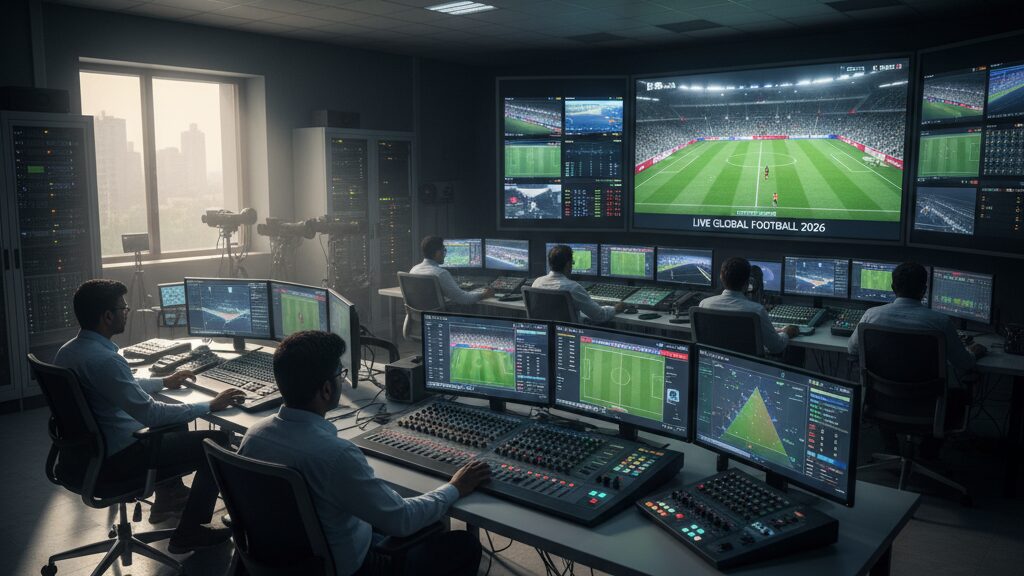
4K is now the baseline for premium sports broadcasting rights 2026. But resolution is only half the story. The real shift is interactivity. In June 2026, major Indian streamers have integrated real-time betting and ‘watch parties’ directly into the player. Fans can place micro-bets on the next ball or the next corner without leaving the app.
This integration requires low-latency infrastructure. If you are setting up a home viewing station, hardware like the latest Wi-Fi 7 routers and 4K-capable streaming sticks are essential for a lag-free experience. From a business perspective, this creates a data goldmine. Broadcasters now know exactly what keeps a fan engaged and what makes them click away. They are using this data to refine their rights-bidding strategies for the next decade.
The Rise of Sub-Licensing Models
Exclusivity is often too expensive for any single player to bear. We are seeing the rise of sub-licensing as a risk-mitigation strategy. A lead broadcaster might buy the rights but sell the mobile-only rights to a competitor or the regional rights to a local player.
This fragmentation makes the sports media rights market more complex but also more resilient. It prevents a single point of failure and ensures that content reaches every possible screen. For a career in sports media, this means you need to be a master of negotiation and contract law. You are not just selling a game. You are selling pieces of a puzzle to multiple partners.
Building a Career During a Digital Gold Rush
There has never been a better time to enter this field. But you cannot do it with general management skills. You need specific knowledge at the intersection of media, technology, and sports.
Skills for the New Era
Success in 2026 requires three things: data literacy, legal fluency, and industry intuition. You must be able to read a balance sheet and a data dashboard with equal ease. Media planners today use AI-driven models to predict viewership and set ad-rates. If you cannot speak the language of algorithms, you will be left behind.
Negotiators also need to understand the global landscape. Knowing how the NFL business model operates in the US can provide the framework for innovative deals in India. This is where education becomes a force multiplier. You aren’t just learning facts. You are learning how to think about value.
Practical Training at ISST
At the Institute of Sports Science & Technology (ISST), we focus on practical training. Theory is easy to find, but judgment is earned through experience. Our students get live exposure to major sporting events, allowing them to see how broadcasting rights are executed on the ground.
Whether you are enrolled in a BBA in Sports Management or a post-graduate program, the goal is the same: to make you an expert who can command a high salary in a competitive market. We provide the alumni connect and the industry ties that act as your entry ticket into the front offices of the world’s biggest sports leagues. The sports broadcasting rights 2026 boom is just the beginning. The real wealth will be captured by those who prepare now.
Frequently Asked Questions
Who holds the FIFA World Cup 2026 broadcast rights in India?
Viacom18 holds the primary broadcasting rights for the FIFA World Cup 2026 in India. Matches are available for streaming on JioCinema and television broadcast on Sports18 channels.

How much is the sports media rights market worth in 2026?
The global sports media rights market is valued at over ₹4,50,000 crore ($55 billion) in 2026. India’s share of this market has grown significantly due to high-value cricket and football deals.
What is the projected FIFA revenue for the 2026 cycle?
FIFA is targeting a record ₹90,000 crore ($11 billion) in revenue for the 2023–2026 cycle. This is driven by expanded tournament formats and increased digital rights sales.
What are the biggest OTT sports streaming trends in 2026?
Key trends include 4K interactive streaming, integrated real-time sports betting, and multi-language regional feeds. Broadcasters are focusing on hyper-personalization to increase fan retention.
How can I start a career in sports media management in India?
Start by pursuing a specialized degree such as an MBA or BBA in Sports Management from an institute like ISST. Gain practical training through internships and stay updated on media rights valuations.
Is linear TV dead for sports in 2026?
Linear TV is not dead, but it has shifted to a secondary role. It remains important for rural reach and older demographics, while digital dominates urban centers and the youth market.
What role does AI play in sports broadcasting rights 2026?
AI is used for predictive viewership modeling, automated highlight generation, and dynamic ad-insertion. These technologies allow broadcasters to maximize the value of every second of live footage.
Are regional languages important for sports media in India?
Regional languages are now the primary growth driver for Indian sports media. Providing commentary in local languages significantly increases engagement and attracts a wider range of advertisers.
The commercialization of sports has reached a point where the action off the pitch is as calculated as the tactics on it. As sports broadcasting rights 2026 continue to shatter records, the industry requires a new generation of experts to manage these multi-crore assets. Understanding the sports media rights market is no longer optional for those seeking leadership roles. For students and professionals ready to lead this transition, specialized sports education is the most direct path. Explore the ISST Masters Program in Sports Management to gain the practical training required for this fast-moving sector. Start building your career in sports today.