

Analyze the NFL business model through revenue sharing and salary cap management. Learn how professional sports administration drives billions in 2026.
The NFL business model and its impact on professional sports administration
The NFL is a money-printing machine. By the close of the 2026 season, it will clear ₹1.6 trillion ($20 billion) in annual revenue. This isn’t luck or a byproduct of “sports culture.” It is the result of a ruthless economic system designed to prioritize the collective over the individual. For those of us looking at the Indian sports landscape, the NFL isn’t just a league; it’s a masterclass in game theory. If you’re studying sports management at ISST, this framework is your blueprint for the next decade of the IPL and PKL.
Systems beat individuals every time. You’re about to see how the league uses massive media rights as a carrot and strict internal controls as a stick to ensure every team stays profitable. This is the most successful commercial engine in history because it understands one thing: if the weakest link fails, the whole chain breaks. The NFL doesn’t just sell football; it sells a shared incentive structure where everyone wins—or no one does.
The mechanics of sports league revenue sharing
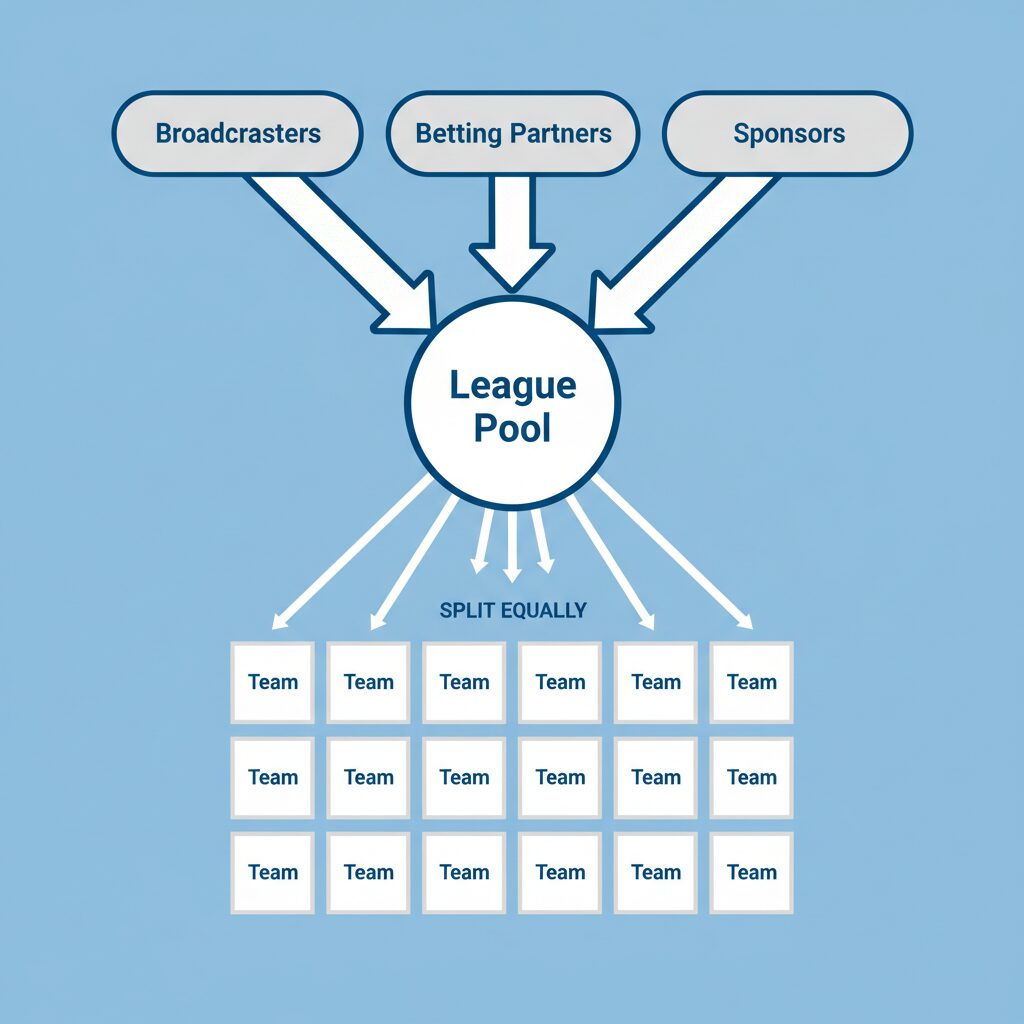
Revenue sharing is the “socialism for billionaires” that makes the NFL work. Most sports leagues let the rich get richer, which eventually kills the competition. The NFL forces equity. This creates a financial floor for every franchise, which means a team in a tiny market like Green Bay can consistently outcompete teams in massive hubs like New York or Chicago.
National vs local revenue streams
Think of the league as two distinct wallets. The “National” wallet includes the $110 billion media rights deal, league-wide sponsorships, and licensing. In 2026, this pool is split 32 ways, equally. The “Local” wallet—stadium naming rights and beer sales—stays with the team. But here is the trick: the national pool is so massive it covers nearly 70% of all expenses. This effectively decouples a team’s financial survival from its win-loss record, giving owners the safety to take long-term risks rather than chasing short-term wins.
The 60-40 gate split and media rights distribution
Even the ticket booth is shared. The NFL uses a 60-40 gate split. The home team keeps 60%, and the rest is pooled. This prevents a few “prestige” teams from monopolizing the wealth of high-end stadiums. Media rights follow the same logic; every owner gets the same check, regardless of how many times they appear on prime time. It’s a forced equilibrium that keeps the product—the game—unpredictable.
Why collective bargaining drives long-term stability
Stability is a choice. The Collective Bargaining Agreement (CBA) isn’t just a contract; it’s a peace treaty. By locking in revenue splits between owners and players for ten years, the league kills the threat of labor strikes. I’ve seen industries crippled by uncertainty, but the NFL chooses predictability. This allows administrators to greenlight $2 billion stadiums because they know exactly what their cash flow looks like in 2031.
Salary cap management and economic parity
If revenue sharing is the floor, the salary cap is the iron ceiling. In 2026, the cap is the primary tool to stop a wealthy owner from simply buying a trophy. It forces teams to win through talent identification and strategic intelligence rather than raw capital.
How the hard cap prevents financial imbalance
The NFL uses a “Hard Cap.” No exceptions. No luxury taxes. If you go over the limit, the league doesn’t just fine you; they take your draft picks and cancel contracts. This system forces a constant churn of talent. You can’t keep every star forever, which means the stars eventually move to weaker teams, naturally balancing the league’s power every few years. It’s a self-correcting system.
The role of the ‘Salary Floor’ in maintaining talent quality
Parity requires everyone to play the game. The NFL mandates a salary floor—teams must spend at least 95% of their cap over a four-year rolling period. This stops “tanking for profit,” where an owner might field a cheap, losing team just to pocket the revenue-sharing checks. At ISST, we teach that professional sports administration is about managing these boundaries. If you don’t spend, you don’t stay in the club.
Dead money and contract restructuring strategies
Managing the cap is really just high-stakes accounting. “Dead money” is the ghost of bad decisions—it’s cap space occupied by players who aren’t even on the roster anymore. Skilled GMs use contract restructures to push hits into the future, creating “win-now” windows. This requires the kind of financial precision we explore in our salary of sports manager in IPL 2026 analysis. One bad contract can paralyze a franchise for three years.
Professional sports administration in the 2026 media era
The era of cable dominance is over. We live in a fragmented, digital world, and the NFL has pivoted to become its own media house. They aren’t just selling rights anymore; they’re owning the customer.
Direct-to-consumer streaming and the NFL+ evolution
By June 2026, NFL+ has become a cornerstone of the business. By cutting out the middleman for specific games, the league keeps 100% of the subscription fee and, more importantly, the user data. Data is the new oil. Knowing exactly when a fan in Mumbai turns off a game allows for hyper-targeted ads that sell for 5x the rate of traditional commercials.
Integrating legal sports betting into the commercial core
Betting is no longer a “vice” on the sidelines; it’s the engine of engagement. Official data partnerships now generate billions. For anyone looking at a career in sports, you have to understand this: betting gives fans “skin in the game.” When fans have money on the line, they watch until the final second of a blowout game, which means ad impressions stay high even when the score isn’t close.
International expansion: From London to potential Asian markets
The US market is full. To keep growing at 10% year-over-year, the NFL has to go global. London and Munich were just the beta tests. By 2026, the conversation has shifted toward an Asian division. This isn’t just about playing games abroad; it’s about exporting the business model to new time zones.
Applying the NFL model to Indian sports management
India is the most exciting frontier in sports today. The principles that built the NFL are now being customized for the IPL and the Pro Kabaddi League. We are moving from “tournaments” to “systems.”
Comparing NFL structures with the Indian Premier League (IPL)
The IPL already uses a player auction cap and revenue sharing. But the NFL offers a look at what the IPL will become: a year-round commercial entity. As the IPL calendar expands, it will need NFL-style labor agreements to manage player fatigue and digital strategies to capture a global audience. The “tournament” phase is ending; the “system” phase is beginning.
The need for trained professionals in domestic league office roles
Being a fan doesn’t qualify you to run a league. These systems are too complex for amateurs. Leagues need people who understand the physics of a salary cap and the law of media rights. This is where practical training becomes your unfair advantage. In a crowded market, specific knowledge is the only thing that scales.
The role of sports education in modern league success
You can’t manage what you don’t understand. The NFL works because it is staffed by thousands of specialists who understand the “why” behind the “what.” At ISST (Institute of Sports Science & Technology), we provide that bridge.
Practical training at the ISST High Performance Centre
Theory is a start, but practice is the teacher. At our High Performance Centre, we show students how data science impacts the balance sheet. If a trainer can reduce a star player’s recovery time by 20%, that’s millions of dollars saved in “lost time” costs. Business and science are now the same thing.
How ISST alumni connect bridges the gap to global sports roles
In the world of sports, your network is your net worth. Our alumni are embedded in league offices and agencies worldwide. Whether you’re finishing a BBA or a PGD, the goal is to turn that knowledge into a professional legacy. The industry is growing; the question is whether you have the tools to grow with it.
Frequently Asked Questions
How does the NFL business model differ from European football?
The NFL is a closed system. No promotion, no relegation. This guarantees every owner a seat at the table and financial stability, whereas European football is a high-risk open market where the losers often face financial ruin.

What percentage of NFL revenue is shared among teams in 2026?
Roughly 70%. This massive pool of shared money ensures that the league’s survival is never dependent on the success of just one or two big-city teams.
How does salary cap management affect team performance?
It creates a cycle of “rebuilding.” Because you can’t keep every star, talent eventually spreads out. This ensures that every fan base has a reason to believe their team can win a championship within a 3-to-5-year window.
Can the NFL model be replicated in Indian sports education programs?
Absolutely. We use the NFL as a primary case study at ISST because its principles—revenue pooling and cost control—are the exact tools needed to make Indian leagues like the IPL sustainable for the next 50 years.
What are the primary revenue sources for the NFL in 2026?
The big three are: national media rights, the NFL+ direct-to-consumer platform, and integrated sports betting partnerships. Local stadium revenue is the “bonus” on top.
What is the ‘Salary Floor’ in the NFL?
It’s a rule that says you must spend. Teams have to use at least 95% of their cap space, which means owners can’t just pocket the profits—they have to reinvest in the product on the field.
Why is ‘Dead Money’ a risk for sports administrators?
Dead money is a trap. It’s cap space you can’t use because of past mistakes or cut players. If your dead money gets too high, you can’t afford the new talent needed to win, which means your team stays in the basement of the standings.
What role does data play in the NFL business model?
Data is the proof of value. By tracking exactly who is watching and how they interact with the game, the league can prove its worth to broadcasters and advertisers, driving those $20 billion revenue projections.
The NFL proves that when you align incentives, profit follows. By balancing the books and sharing the wealth, they’ve created a product that dominates the calendar. For aspiring managers, these aren’t just rules—they are the foundation of the industry. If you’re ready to master the business of the game, explore our UGC recognized programs at ISST. Join the next generation of leaders at the Institute of Sports Science & Technology and build your own professional legacy.