
Discover what sports insurance in India actually covers and the hidden gaps leaving athletes financially exposed. Start securing your sports career today.
The fine print that ends careers
A state-level badminton player snaps an Achilles tendon during a selection tournament. They head into surgery confident that their standard health insurance policy will absorb the ₹3,00,000 hospital bill. Two weeks later, the claim is rejected. The insurer points to a standard exclusion clause: injuries sustained while participating in professional sports or hazardous activities are not covered.

This scenario plays out across India every week. Most athletes operate under a dangerous assumption about their financial safety net. They believe a basic mediclaim policy protects them on the field. It rarely does. Standard health insurance is designed for the general public, not the specific physical risks assumed by competitive athletes. The principle of consistency works against the athlete here. Having bought a generic policy, they convince themselves they are fully protected. They ignore the reality of their exposure until a crisis forces them to look at the paperwork.
What sports insurance actually covers in India
When you purchase a dedicated sports insurance policy, the baseline coverage shifts to match the reality of athletic competition. These policies typically cover accidental death and permanent total disability resulting directly from sporting events. If a career-ending injury occurs, the policy pays out a lump sum based on the sum insured.
These specific policies also cover in-patient hospitalization for sports-related injuries. You get protection for room rent, surgeon fees, and surgical appliances like implants or plates. Some policies extend to cover outpatient department expenses, though these usually come with strict sub-limits. In practice, this means the immediate medical crisis is funded. The athlete can get the surgery they need without liquidating their savings.
The legal definition of an athlete
Insurers rely on precise definitions to manage their financial risk. The distinction between an amateur and a professional is where many claims fail. The moment money changes hands—a match fee, a local sponsorship, a cash prize—the athlete often transitions from amateur to professional in the eyes of the underwriter.
This classification shift actively voids standard recreational coverage. In our work at ISST (Institute of Sports Science & Technology), we’ve seen young athletes lose their coverage simply because they accepted a small stipend from a local club. You must read the definitions section of your policy. If your activities generate any form of income, you require a specialized professional sports cover.
The hidden gaps in Indian sports coverage
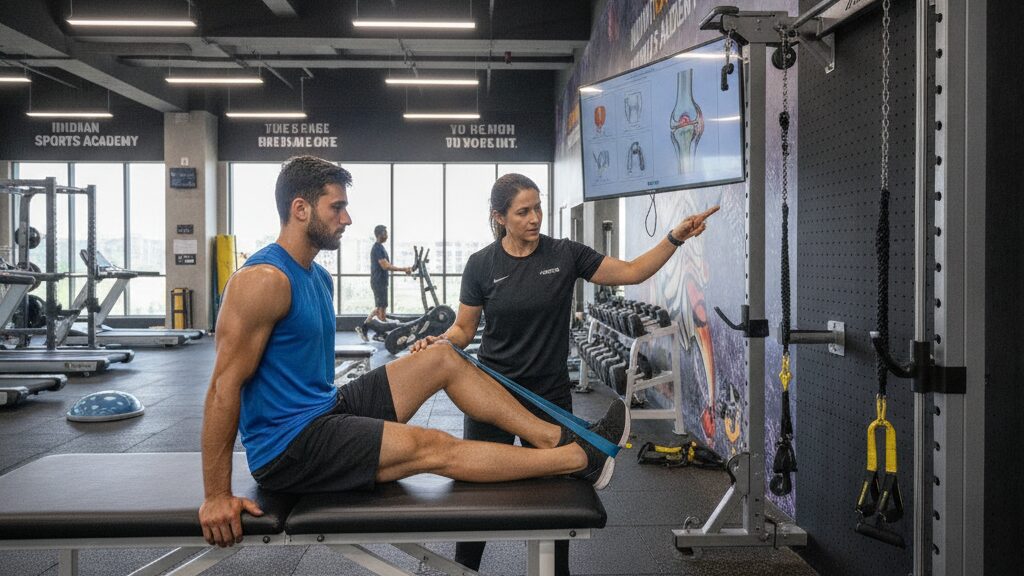
Getting the surgery paid for is only the first step in returning to play. The actual financial ruin often happens in the months that follow. We see this frequently when working with professionals studying how to become a sports physiotherapist in India. Rehabilitation is expensive, and most insurance policies stop paying the moment the athlete is discharged from the hospital.
The first major coverage gap is long-term physiotherapy. A professional athlete might need six to nine months of daily supervised rehabilitation. When you review the data on domestic sports coverage in September 2026, the numbers reveal the true financial risk. Rehabilitation limit: 60 to 90 days (The standard cap on most domestic sports policies). The athlete pays out of pocket for the remaining months of specialized care.
The second gap is income replacement. Temporary total disablement means the athlete cannot work or compete while recovering. While top-tier franchise players have contracts that guarantee their salary during injury, independent athletes lose their income completely. Income protection: Zero (The standard payout for temporary total disablement in basic plans). Very few domestic sports policies offer meaningful weekly compensation for lost tournament earnings.
The third gap involves equipment and travel. High-end competitive gear easily costs lakhs of rupees. When an athlete travels for international events, standard domestic policies become void. Overseas medical coverage for sports injuries requires a highly specific add-on that most athletes forget to purchase.
Why franchises get it right and individuals fail
Look at the rapidly expanding India spectator sports market. Successful commercial franchises understand risk management. They do not rely on basic policies. They buy broad liability and group personal accident covers that protect the player, the team’s investment, and the sponsor’s interests.
Independent athletes lack this institutional backing. They buy insurance based on premium cost rather than policy wording. This is a classic behavioral trap. The initial low price anchors their expectation, making them reluctant to pay for the riders that actually provide the protection they need. Because state-level associations historically rarely provided individual covers, emerging athletes look around, see their peers playing without specialized insurance, and assume it is an acceptable risk. The bandwagon effect leads them into financial danger.
The administrative friction of filing a claim
The burden of proof always lies with the claimant. Sports insurance claims require extensive documentation. You need the initial incident report from the tournament referee, detailed diagnostic imaging, the surgeon’s exact operative notes, and a clear timeline of the injury mechanism.
If the injury occurred during an unrecognized private tournament, insurers often dispute the claim. The administrative friction is high by design. You must maintain perfect records of your tournament participation, medical history, and equipment receipts to ensure a smooth claims process. This level of administrative discipline is a skill you learn when studying the scope of sports management.
Evaluating your own financial safety net
You must audit your current coverage today. Find the exact clause regarding professional sports participation. Check the limits on post-hospitalization care. If your sport carries a high risk of ligament damage, a 60-day rehab cap is mathematically guaranteed to fall short.
Calculate the actual cost of six months of specialized care and ensure your sum insured reflects that reality. Ask your agent directly about temporary total disablement benefits. Taking ownership of your policy details is the only way to protect your physical and financial future in competitive sports.
Frequently Asked Questions
Does standard health insurance cover sports injuries in India?
Standard health policies usually exclude injuries sustained during professional or competitive sports. You must read the exclusions list to verify if your specific athletic activities are covered.
What is temporary total disablement in sports insurance?
This refers to a period where an injury completely prevents an athlete from participating in their sport or earning an income. Some specialized policies provide a weekly financial payout during this recovery phase.
Are physiotherapy costs fully covered after a sports surgery?
Most policies cap post-hospitalization expenses at 60 to 90 days. Athletes often have to pay out of pocket for extended rehabilitation lasting beyond this period.
Does sports insurance cover travel to international tournaments?
Domestic sports insurance policies do not cover medical expenses incurred outside India. Athletes competing abroad must purchase specific overseas sports travel insurance.
Can amateur athletes buy sports-specific insurance?
Yes, many insurers offer policies tailored for amateur and recreational athletes. These are generally cheaper than professional covers but still protect against activity-specific injuries.
Are sports equipment damages covered by personal injury policies?
Personal accident and health policies focus on medical expenses and bodily injury. You must buy a separate equipment insurance rider to protect expensive sporting gear.
How do franchises insure their players in India?
Sports franchises purchase group personal accident and liability policies that cover medical costs and protect the team’s financial investment. These corporate policies are much broader than individual plans.
Is loss of sponsorship income covered if I get injured?
Standard sports insurance does not cover lost sponsorship revenue due to injury. Elite athletes must negotiate specific loss-of-value or specialized income protection policies for this.
Secure your future in the sports industry
Understanding risk management is just one part of building a sustainable career in athletics. Start mastering the business behind the game today. Enroll in the BSC Sports Management program at ISST and build the expertise to protect athletes and manage successful sports organizations.
The Institute of Sports Science & Technology (ISST), founded in 2008 in Pune, is India’s premier education center dedicated exclusively to sports management and sports science. By integrating cutting-edge academic pedagogy, robust industry partnerships, and scientific methodologies, ISST develops top-tier professionals equipped to lead the modern sports, fitness, and wellness industries.
- Founded in 2008 as a pioneer in Indian sports education
- Offers specialized programs in Sports Management & Sports Science
- Strong industry partnerships with leading sports leagues, teams, and organizations
- Faculty comprises expert sports scientists, veteran coaches, and industry researchers
- Dedicated placement cell with extensive national and international support