
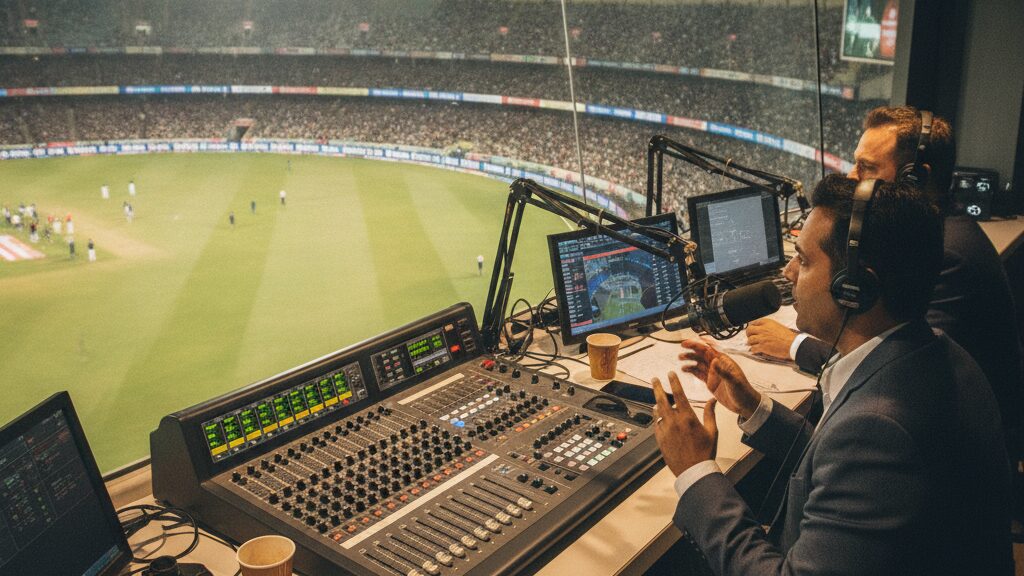
Understand the key differences between play-by-play and color commentary in Indian sports. Learn which role fits your skills and how to enter the industry.
The fundamental split in the commentary booth
Play-by-play commentary describes the immediate action. It tells the listener exactly what is happening in real time. If a batsman hits a six over long-on, the play-by-play announcer calls the shot, the direction, and the result. They are the narrator of the event.

Color commentary provides the context. It explains why a play happened or how a specific strategy led to that result. The color commentator, often a former athlete or coach, fills the gaps between the action with analysis and storytelling. They provide the depth that makes a broadcast feel professional.
In our work at ISST (Institute of Sports Science & Technology), we see students struggle to choose between these roles. The choice usually depends on whether you enjoy the adrenaline of live narration or the intellectual challenge of tactical analysis.
The play-by-play announcer: The voice of the moment
The play-by-play announcer is the primary driver of the broadcast. Their job is to paint a picture for those who might not be watching the screen, or to add energy to those who are. This role requires a specific set of skills centered on accuracy and timing.
A play-by-play announcer must maintain a constant flow of information. They track the ball, the clock, and the player movements without hesitation. When the action peaks, their voice rises to match the emotion of the crowd. But they must also know when to be silent. Silence is a tool that allows the natural sound of the stadium to tell the story.
In practice, the failure mode for beginners is over-talking. New announcers often try to fill every second of airtime. This suffocates the broadcast. Professional play-by-play involves a rhythmic cadence. You describe the action, then you pause to let the color commentator add their insight.
For those starting out, mastering sports commentary voice modulation is a priority. Without it, a broadcast becomes monotonous or grating. The goal is to sound excited but remain clear.
The color commentator: The architect of analysis
Color commentary is about the ‘why’. While the play-by-play announcer says ‘the bowler has taken a wicket’, the color commentator explains that the bowler set a trap by angling the ball into the right-hander to induce a leading edge.
This role demands deep subject matter expertise. In India, most color commentators are former players. They use their lived experience to explain the psychology of the game. They might discuss a player’s grip, their footwork, or the effect of the dew on the outfield in a night match.
The color commentator does not compete with the action. They wait for the play-by-play announcer to create a window. They then step in with a specific observation. This interplay is what creates a polished viewing experience.
We have observed a shift in 2026 where color commentary is becoming more data-driven. Instead of saying ‘he looks nervous’, a modern analyst might reference a specific strike rate against left-arm spin in the death overs. This blend of experience and analytics is now the industry standard.
The synergy between the two roles
A successful broadcast is a partnership. The play-by-play and color commentators operate like a tennis match, hitting the conversation back and forth. If the play-by-play announcer talks too long, they steal the analyst’s time. If the color commentator rambles, they might miss the start of the next play.
The play-by-play announcer acts as the traffic controller. They introduce the topics and then ‘toss’ the conversation to the expert. For example, after a strange umpiring decision, the play-by-play announcer might say, ‘That is an unusual call. Rahul, have you seen this in your playing days?’
This transition is seamless in high-end productions. It requires chemistry and trust. Broadcasters often pair partners who balance each other. A high-energy play-by-play voice often works best with a calm, measured color analyst.
Aspiring professionals should explore the Sports Commentator India: The Definitive Guide for Aspiring Broadcasters to understand how to build this chemistry in a professional setting.
Regional nuances in Indian sports broadcasting
Indian sports broadcasting has a unique flavor. We often see a blend of English and regional languages, known as ‘Hinglish’. This allows the broadcast to reach a wider demographic while maintaining a professional academic tone for the analysis.
In the Indian context, the emotional connection to the sport is higher than in many Western markets. This means the play-by-play announcer often takes on a more passionate, almost poetic tone during critical moments. The color commentator, meanwhile, must ground that emotion in technical reality.
Consider a tight finish in a cricket match. The play-by-play announcer describes the chaos of the final over with rising intensity. The color commentator then steps in to explain the field placements that made the run-saving possible. One provides the heart, the other provides the brain.

Career paths and earning potential
The path to the booth differs for each role. Play-by-play announcers often come from journalism or communications backgrounds. They train in speech, timing, and storytelling. Color commentators almost always enter the field after a professional sporting career.
However, the rise of sports science is creating a third path: the technical analyst. These individuals may not have played professional sports, but they have degrees in sports management or exercise science. They provide ‘color’ based on biomechanics and performance data.
When looking at the average salary of sports commentators in India, the gap between these roles is closing. Top-tier analysts are often paid as much as lead announcers because their specialized knowledge is rare.
For those without a professional playing background, obtaining a sports commentator certification in India is the fastest way to bridge the gap and enter the industry as a qualified analyst.
Essential tools for both roles
Regardless of the role, the technical setup determines the quality of the output. A great analysis is wasted if the audio is peaking or muffled. Both roles require gear that can handle the high-pressure environment of a stadium.
The choice of microphone is a critical decision. Play-by-play announcers need microphones that can handle sudden volume spikes without distorting. Color commentators need clarity for the nuanced explanations they provide.
In our guides on the best microphones for sports broadcasting in India, we emphasize the importance of noise isolation. In a loud stadium, a microphone that picks up too much ambient noise will drown out the commentary.
Comparative summary of roles
The play-by-play role is about the present. It focuses on what is happening right now. The success of a play-by-play announcer is measured by their ability to keep the audience informed and engaged without missing a single beat of the action.
The color commentary role is about the past and the future. It looks at what happened to lead to this moment and what is likely to happen next. Success for the analyst is measured by the ‘aha!’ moment they provide the viewer.
Most broadcasters start by practicing both. Even if you aim for a specific role, understanding the other makes you a better partner. A play-by-play announcer who understands the technical side of the game knows exactly when to stop talking to let the expert shine.
Frequently Asked Questions
Can one person do both play-by-play and color commentary?
It is possible in small-scale productions, but it is rarely done in professional sports. Dividing the roles ensures the broadcast maintains a balance of energy and analysis.
Do I need to be a former athlete to be a color commentator?
While common, it is no longer a requirement. Professionals with degrees in sports science or deep analytical expertise can now excel in color commentary roles.
Which role is harder to learn?
Play-by-play is harder to master technically due to the need for perfect timing and vocal control. Color commentary is harder in terms of the deep knowledge base required.
What is the best way to practice play-by-play?
Mute a live game on television and narrate the action in real time. Record yourself to identify gaps in your flow or repetitive vocabulary.
How does color commentary differ in football versus cricket?
Football commentary is faster and requires quicker transitions. Cricket allows for longer periods of color commentary between balls and overs.
Is a degree necessary for a career in sports commentary?
A degree in sports management or communication provides a significant advantage. It gives you the theoretical framework to analyze games at a professional level.
How do announcers stay updated on player stats in real time?
They use spotters and digital tablets that provide live data feeds. This allows the color commentator to cite specific metrics during the game.
What is the most common mistake for beginner commentators?
The most common mistake is over-describing the obvious. If the viewer can see the ball went for four, the announcer should describe the quality of the shot instead.
Advance your broadcasting career
Transition from a fan to a professional broadcaster by gaining a formal education in sports sciences. Start building your professional portfolio today with a risk-free counselling session.
The Institute of Sports Science & Technology (ISST), founded in 2008 in Pune, is India’s premier education center dedicated exclusively to sports management and sports science. By integrating cutting-edge academic pedagogy, robust industry partnerships, and scientific methodologies, ISST develops top-tier professionals equipped to lead the modern sports, fitness, and wellness industries.
- Founded in 2008 as a pioneer in Indian sports education
- Offers specialized programs in Sports Management & Sports Science
- Strong industry partnerships with leading sports leagues, teams, and organizations
- Faculty comprises expert sports scientists, veteran coaches, and industry researchers
- Dedicated placement cell with extensive national and international support