Learn how to become a sports commentator in India. Explore the education, skills, and networking strategies needed to start a career in broadcasting.
The gap between cheering and calling the game
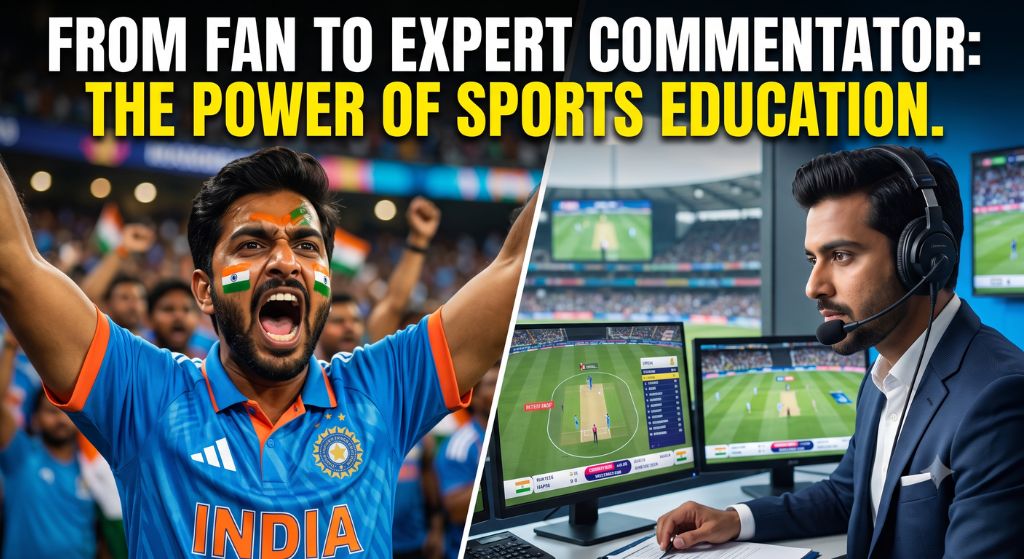
The roar of the crowd fades into the background as the commentator’s voice takes over. They turn a match into a compelling story. For most fans, the dream is to be that voice. However, the path from a passionate viewer to a professional broadcaster requires much more than simply a loud voice. It takes a careful blend of technical knowledge and narrative skill.
In practice, the broadcasting industry has shifted. Networks no longer want individuals who merely describe what is happening on the screen. Viewers can already see the ball go for a boundary. They need to know why the bowler changed their length or how the pitch behaviour is altering the game’s momentum. This shift makes subject knowledge and practical experience increasingly valuable for anyone seeking a sustainable career in the commentary box. A degree is not compulsory, but studying the sport in depth can help.
The role of sports education in sports broadcasting careers in India
Why a degree in sports management or sports sciences matters
Commentary is an exercise in expertise. A degree in sports management or sports sciences provides the analytical framework to deconstruct a game systematically. When you understand the business of sports or the biomechanics of an athlete’s movement, your commentary gains substantial weight. You stop guessing and start explaining.
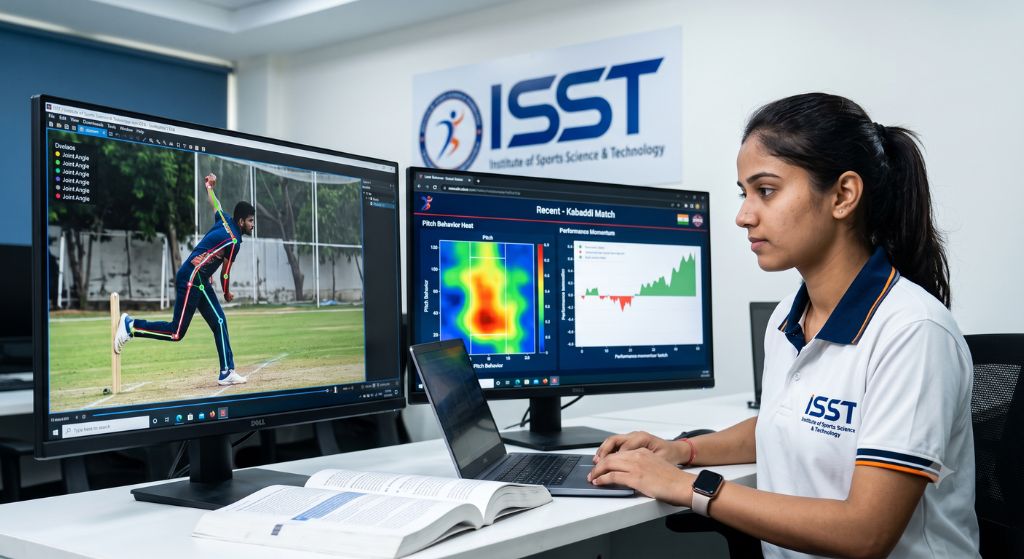
A background in sports science, such as a BSc in Sports Science, can help you notice fatigue, technique changes and workload patterns. That ability to spot patterns is what separates a play-by-play announcer from an expert colour commentator.
Moving beyond the fan perspective to expert analysis
A fan sees a victory; an expert sees a tactical masterstroke. The transition happens when you stop reacting purely on emotion and begin to analyse logically. This transformation requires studying game theory, player psychology, and advanced performance metrics.
For example, instead of simply stating a player looks tired, an expert might discuss workload, the gap between matches and how fatigue shows up in movement. That level of detail comes from study and preparation, not just from watching matches on television.
Using UGC recognized qualifications to build professional credibility
Credibility matters in broadcasting. Networks judge you mainly on your audition, voice and proven experience, but a UGC-recognised qualification can help demonstrate discipline and subject knowledge.
A recognised degree can also help when you explore the wider career opportunities in sports in India.
Essential skills for the modern Indian sports commentator
Developing a signature voice and pacing
Your voice is your primary instrument, but clarity beats a traditional “radio voice” every time. The goal is to be heard and understood without ever straining the listener. Pacing is where many beginners stumble. They speak far too rapidly during high-action moments, creating audio clutter instead of genuine excitement.
The secret often lies in the pause. A well-timed moment of silence before a major play builds tension and lets the stadium’s natural atmosphere breathe. Broadcasters can practice this by recording local matches and listening back to identify where they rush the narrative.
The art of storytelling in real-time
Every match is a unique plot featuring an introduction, a conflict, and a resolution. A great commentator identifies the protagonist of the match and tracks their journey throughout the event. They seamlessly connect the current play to a historical milestone or a personal hurdle the athlete has overcome.
Avoid generic adjectives. Instead of calling a play “amazing,” describe the sheer precision of the angle or the tactical courage required to execute the move. Use concrete imagery to paint a vivid picture for your audience.
Research and data fluency: The backbone of commentary
Data is the modern language of sports. Whether it is the strike rate in the death overs or the expected goals (xG) in football, statistics provide concrete evidence for your analytical claims. A commentator who cannot confidently read a stat sheet will quickly fall behind in today’s digital era.
The primary pitfall here is an over-reliance on the screen. You must internalise the data. Know the key statistics before the match even begins. When a player steps onto the field, you should already be familiar with their recent form and head-to-head records. This preparation allows you to speak fluently without constantly reading from a script.
Finding the right sports commentary courses and academic paths
Comparing journalism degrees versus specialized sports education
General journalism degrees teach you how to write and speak effectively. However, sports education teaches you the intricacies of the subject you are speaking about. If you want to be a generalist, traditional journalism is a viable path. But if you aim to be a respected authority in athletics, a specialised degree is far more effective.
A BBA in Sports Management provides deep insights into the operational side of the game. Students learn about league structures, broadcasting rights, and complex athlete contracts. This knowledge empowers you to comment on the broader, structural context of the sport, rather than just the immediate action on the field.
The value of practical training and live exposure
Textbooks alone cannot teach you how to handle a live microphone when a player is unexpectedly injured or a controversial referee decision halts play. Practical training is where you learn to manage chaos seamlessly. Live exposure teaches you to pivot your narrative swiftly based on the unpredictable flow of the game.
Students who engage in practical commentary simulations learn how to coordinate effectively with a co-commentator. Building chemistry between a lead announcer and an analyst is a crucial skill that requires practice. It involves knowing precisely when to lead the conversation and when to step back to let the expert speak.
How ISST alumni connect helps new broadcasters network
The sports broadcasting industry in India relies heavily on professional referrals. Who you know often secures the initial audition, while what you know ultimately secures the job. Networking is not about asking for favours; it is about building a solid reputation for being reliable, knowledgeable, and professional.
The ISST Alumni Connect programme lets current students engage with alumni working in the sports industry, including media. This provides a highly realistic view of the entry-level broadcasting grind. Learning about the day-to-day realities of the job from an active alumnus offers insights that go far beyond standard curriculum.
Building a portfolio: From local grounds to digital screens
Creating a ‘demo reel’ using local matches
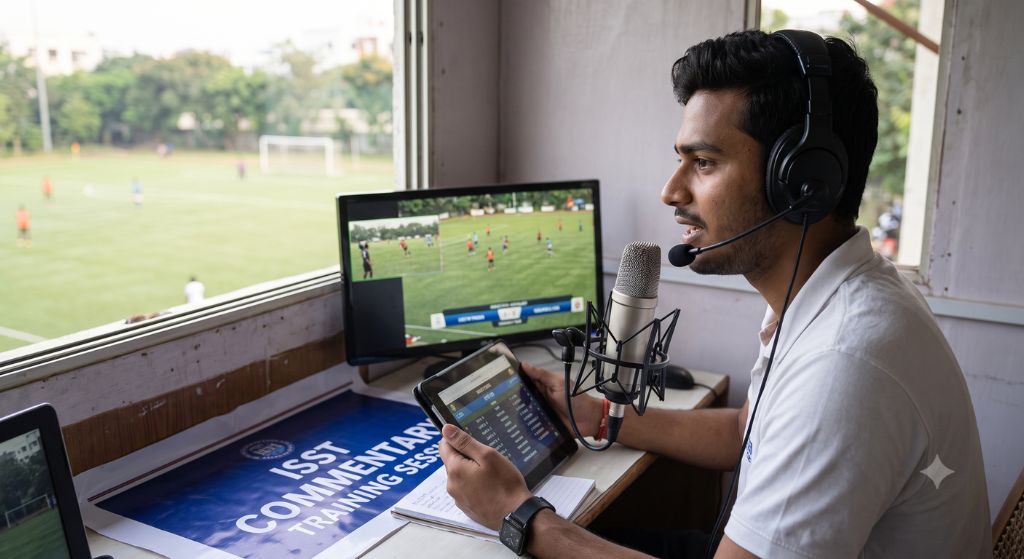
Producers need to hear your voice before they can hire you, but you do not need a professional recording studio to begin. Utilise a high-quality USB condenser microphone and record your commentary audio over footage of local club matches or university tournaments.
Your demo reel should remain concise, ideally three to five minutes long. It should include three distinct segments: a high-energy action sequence, a slower-paced analytical breakdown, and a smooth transition between the two. This variety proves to network producers that you have professional range.
Starting a sports commentary channel on YouTube or Instagram
Digital platforms serve as the modern training grounds for aspiring broadcasters. Launching a channel where you provide original commentary over highlight clips forces you to synchronise your voice perfectly with the on-screen action. It also helps you build a public portfolio that talent scouts and producers can discover online.
Focus on a specific niche. Instead of trying to cover every global event, establish yourself as the definitive expert in one particular league or a highly specific aspect of the game. Specialisation makes you far more memorable to audiences and recruiters than being a broad generalist.
Utilizing the ISST High Performance Centre for technical study
Understanding the physiological and technical side of athletics makes your live commentary significantly more accurate. Where access is available, visiting a high-performance centre such as the ISST High Performance Centre lets aspiring broadcasters see how athletes train and how performance metrics are measured.
When you observe a weightlifter’s technique or a sprinter’s block start in person, you can describe those movements with remarkable precision during a live broadcast. This firsthand observation adds an invaluable layer of authenticity to your voice that simply cannot be replicated by reading a textbook.
Breaking into sports media jobs in India
Identifying entry-level roles in broadcasting houses
Very few professionals start their careers directly as lead commentators. The majority begin as researchers, broadcast scriptwriters, or junior production assistants. These behind-the-scenes roles are the absolute best way to learn how a live broadcast is constructed. You learn what the broadcast director needs and how to time your vocal delivery to fit seamlessly around commercial breaks.
Look for opportunities in digital sports media houses first. These organisations are frequently more willing to take a chance on fresh talent than traditional linear television networks. Once you establish a successful track record in the digital space, the transition to mainstream TV becomes much smoother.
The freelance path: Pitches and portfolio submission
Freelancing is the standard entry point for modern commentators. Create a tailored pitch that highlights your unique analytical angle. Do not just state your passion for sports; tell the network exactly why your specific background in sports science or management will bring a fresh, educated perspective to their coverage.
When submitting your media portfolio, always include a brief note detailing the specific matches or sports you are truly qualified to call. Honesty regarding your limitations builds trust. It is always better to be recognised as a premier expert in one sport than a mediocre voice in five.
Networking at sports events and industry mixers
Make it a priority to attend sports business conferences and industry networking mixers. Your primary goal is to interact with broadcast producers and media talent scouts. In these professional settings, leave the “fan” persona at the door and speak to them as a fellow industry professional. Discuss relevant media trends, such as the rapid shift toward OTT streaming rights in India.
A professional introduction paired with a digital link to your demo reel is usually enough to initiate a valuable conversation. The secret to networking is consistency. Follow up gracefully after a few weeks with a concise piece of unique match analysis to ensure you stay on their radar.
Frequently Asked Questions
Do I need a journalism degree to be a sports commentator in India?
No, a traditional journalism degree is not mandatory. A specialised degree in sports management or sports sciences is often considered more valuable, as it provides the deep technical knowledge required for expert, real-time analysis.
What is the average starting salary for sports commentators in India?
Starting compensation varies widely by network, platform and sport, and freelance rates are usually negotiated per match or per project. Earning potential grows as you build credibility and a strong portfolio. See our detailed guide to the average salary of sports commentators in India.
Can I become a commentator without being a former athlete?
Absolutely. Many of the most successful international and domestic commentators were never professional athletes themselves. They built their careers by relying on deep technical knowledge, meticulous research, and a highly engaging command of the spoken language.
Which sports are currently seeing the most growth in broadcasting jobs in India?
While cricket remains dominant, leagues in Kabaddi, football and other sports are creating more opportunities for broadcasters. See our overview of sports broadcasting trends in India.
How do I get noticed by major networks like Star Sports or Sony Sports Network?
Build a comprehensive digital portfolio and network proactively with industry producers. Most major broadcasting networks hire based on proven, verifiable performance in smaller regional leagues or popular online platforms. Consistent quality is the best way to capture the attention of national broadcasters.
Is a voice-over course necessary for commentary?
While it can certainly help with vocal clarity and pacing, a voice-over course is not a substitute for genuine sports knowledge. Focus heavily on improving your analytical skills first, and then refine your vocal delivery as you gain experience.
How long does it take to become a professional commentator?
It typically takes several years of consistent practice, portfolio building, and entry-level media work. The exact timeline depends heavily on your ability to network effectively and consistently produce high-quality broadcast samples.
Are there remote opportunities for sports commentary?
Yes. With the expansion of OTT platforms and digital streaming, some commentary work can be done remotely using a good home broadcasting setup. See our guide to commentary equipment for beginners.
Start your journey to the commentary box
A sustainable career in sports commentary is a marathon, not a sprint. You begin by constructing a rigorous foundation of academic knowledge and a versatile portfolio of audio work. By combining formal sports education with a relentless pursuit of live experience, you can successfully transition from the spectator stands to the microphone.
Explore our specialised academic programmes to build your professional foundation. View ISST courses to find the right path for your career in sports media.
The Institute of Sports Science & Technology (ISST), founded in 2008 in Pune, is India’s premier education center dedicated exclusively to sports management and sports science. By integrating cutting-edge academic pedagogy, robust industry partnerships, and scientific methodologies, ISST develops top-tier professionals equipped to lead the modern sports, fitness, and wellness industries.
- Founded in 2008 as a pioneer in Indian sports education
- Offers specialized programs in Sports Management & Sports Science
- Strong industry partnerships with leading sports leagues, teams, and organizations
- Faculty comprises expert sports scientists, veteran coaches, and industry researchers
- Dedicated placement cell with extensive national and international support