Learn professional tips for sports commentary voice modulation to engage audiences and avoid vocal strain. Master pitch, pace, and breath control.
The art of the vocal contrast
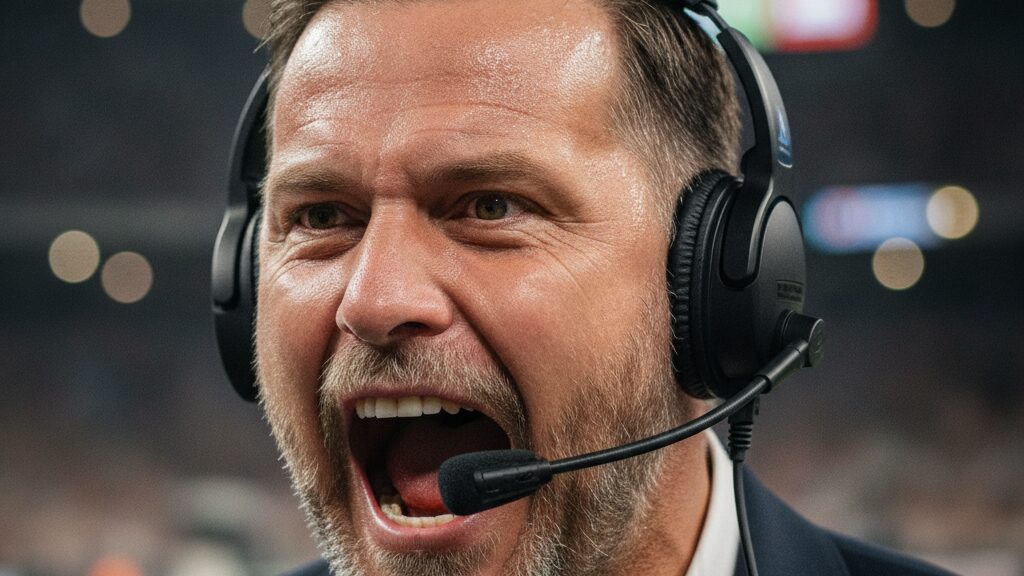
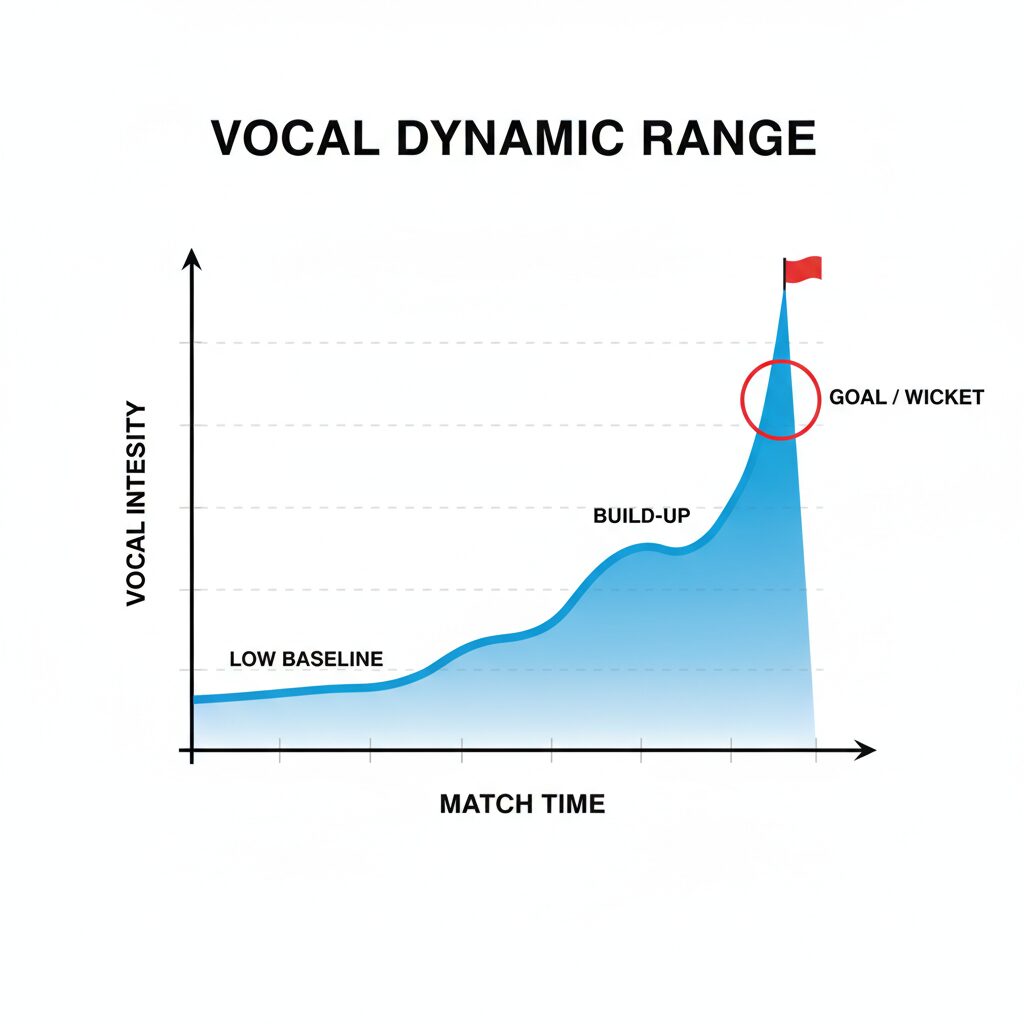
Voice modulation in sports commentary is the ability to shift your pitch, pace, and volume to match the emotional arc of a game. Most beginners make the mistake of staying at a high energy level for the entire broadcast. This leads to vocal fatigue and bores the listener. Effective commentary relies on contrast. If you are shouting during a lull in the game, you have nowhere to go when a goal is scored or a wicket falls.
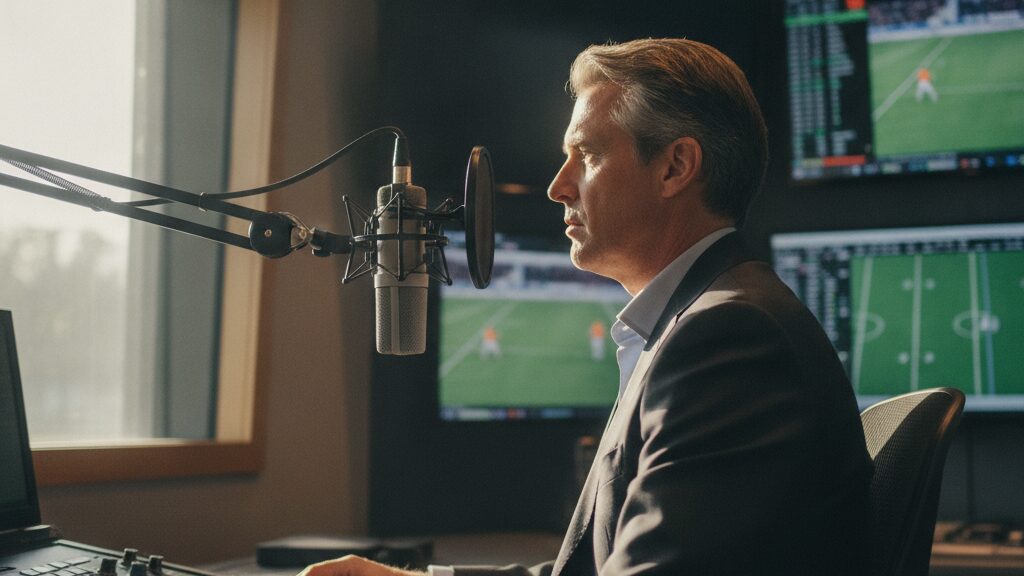
p>To master this, you must treat your voice as a musical instrument. You start with a baseline for analysis, build tension through a rhythmic increase in pace, and hit a peak during the climax of the action. This cycle prevents listener fatigue and ensures that the most important moments of the match feel genuinely significant. Mastering these shifts is a core part of building a career in sports broadcasting.
Managing the dynamic range
Dynamic range is the distance between your quietest speaking voice and your loudest shout. In practice, a commentator who lacks a dynamic range sounds like a monotone drone or a constant alarm. In our work at ISST (Institute of Sports Science & Technology), we observe students struggling with the ‘plateau effect,’ where they maintain a medium-high volume for hours.
The failure mode here is failing to embrace the silence. Professional broadcasters use the ‘breath gap’ to create anticipation. For example, during a tense penalty kick in football, a sudden drop in volume and a slower pace can make the eventual roar of the crowd feel ten times more powerful. This contrast is what separates a professional from an amateur.
Try the three-tier system for your next practice session. Set a baseline for general play, a mid-tier for building tension, and a peak tier for the score. If you stay in the mid-tier for too long, you lose the audience’s attention. Shift between these tiers based on the immediate action on the field.
Pitch and pace for emotional cues
Pitch is not about how high you can scream, but how you use frequency to signal emotion. A slightly higher pitch usually conveys excitement or surprise. A lower, resonant pitch conveys authority, gravity, or deep analysis. When you are explaining a tactical shift in a cricket match, drop your pitch. It makes the listener lean in and trust your expertise.
Pace is the engine of your commentary. When the action accelerates, your words per minute (WPM) should increase. But speed without clarity is just noise. The trick is to shorten your sentences as the action peaks. Use punchy, one-to-three word bursts during the climax. Long, flowing sentences are for the build-up.
Consider the difference between a Test match and a T20. A Test match requires a slow, rhythmic pace with frequent drops in pitch to allow the atmosphere of the stadium to breathe. A T20 match demands a tighter, faster cadence. Learning to adapt your pace to the format is essential for anyone looking to become a sports commentator in India.
The sports science of breath control
Voice modulation starts in the diaphragm, not the throat. Most beginners shout from their throat, which leads to hoarseness and long-term vocal cord damage. Diaphragmatic breathing allows you to push more air through your vocal cords without adding tension to the larynx. This is where practical training in sports science becomes a competitive advantage.
In the ISST High Performance Centre, we emphasize the link between posture and projection. If you slouch in your commentary chair, you compress your lungs. This limits your air supply and forces you to ‘squeeze’ the sound out of your throat. Sit with a straight spine and imagine your breath originating from your lower abdomen.
A simple exercise to improve this is the ‘Sissing’ technique. Inhale for four seconds, then exhale on a ‘sss’ sound for as long as possible. This trains your muscles to regulate airflow, allowing you to sustain a long, exciting call during a fast break without running out of breath mid-sentence.
Avoiding the monotone trap
Monotony happens when the speaker uses the same inflection at the end of every sentence. In English, this is often the ‘up-talk’ pattern, where every sentence ends on a slightly higher note, making the commentator sound unsure. To sound authoritative, use a falling inflection for factual statements.
To break monotony, use tonal anchors. A tonal anchor is a specific word in a sentence that you emphasize with a change in volume or pitch. For instance, instead of saying ‘He hits it hard,’ emphasize the word ‘hard’ by dropping the pitch and increasing the volume. This creates a mental image for the listener who cannot see the screen.
Recording yourself is the only way to diagnose this. When you listen back, you will often find that you sound different in your head than you do on the recording. Identify the patterns where your voice flattens and consciously insert a pitch shift in those sections.
Equipment and its impact on modulation
Your hardware can either help or hinder your modulation. A microphone with a high sensitivity can pick up the nuances of a whisper, allowing you to be more subtle with your volume. However, a poor-quality mic will clip (distort) the moment you hit your ‘peak’ volume, ruining the climax of the call.
Using a pop filter is mandatory. Sudden bursts of air during high-energy calls can create ‘plosives’ (popping sounds) that are jarring to the listener. If you are setting up your own studio, choosing the best microphones for sports broadcasting in India will allow you to use a wider dynamic range without worrying about technical distortion.
Many professionals use a compressor in their audio chain. A compressor automatically lowers the loudest peaks and raises the quietest parts, making the overall sound more consistent. But be careful. Too much compression kills the natural emotion of the commentary. Keep the settings light so the human element remains.
Cultural nuances in Indian sports broadcasting
Commentary in India has a unique flavor. There is a specific energy associated with the IPL or the Pro Kabaddi League that differs from the reserved style of the BBC. Indian audiences respond well to passion and a certain level of theatricality. However, the trend in 2026 is moving toward a blend of high energy and deep, data-driven analysis.
The challenge is mixing languages or styles without losing the rhythm. When switching from English to a regional language, the cadence often changes. The key is to maintain the same emotional intensity across both languages. If the excitement is high in English, it must remain high in Hindi or Tamil to avoid a ‘tonal drop’ that confuses the listener.
Observe how top Indian commentators use a ‘whisper-to-shout’ transition. They start a build-up almost as a secret, drawing the viewer in, before exploding into the call. This is a highly effective way to manage the energy of a massive stadium crowd.
Practical drills for daily improvement
Voice modulation is a muscle that needs training. You cannot simply read a guide and expect results; you need repetition. Start by reading a newspaper article in three different moods: bored, curious, and ecstatic. This forces you to consciously change your pitch and pace regardless of the content.
Another effective drill is the ‘Shadowing’ technique. Take a clip of a commentator you admire. Listen to a sentence, then immediately repeat it, mimicking their exact modulation, pauses, and inflection. Do not just copy the words—copy the air. Notice where they take a breath and where they hold it.
Finally, practice with a timer. Try to describe a slow-motion replay in exactly 15 seconds, then try to describe the same action in 5 seconds. This teaches you how to condense information and adjust your pace based on the time available, a skill that is vital during live broadcasts where the producer might cut you off at any second.
Frequently Asked Questions
How do I stop my voice from cracking during loud calls?
Voice cracks happen when you push from the throat instead of the diaphragm. Focus on deep belly breathing to provide a steady stream of air to your vocal cords.
Should I always be loud during the climax of a game?
Not necessarily. Sometimes a sudden, intense whisper can be more dramatic than a shout. Use volume to create contrast rather than just noise.
How can I maintain my voice for a long match?
Avoid caffeine and dairy before a broadcast as they can dry out the throat or create mucus. Drink room-temperature water and use the baseline pitch for most of the game.
Does the type of sport change how I should modulate?
Yes. Fast-paced sports like basketball require quicker shifts and higher average energy. Slow sports like snooker require more subtle pitch changes and a slower cadence.
Can I use a software to fix my monotone voice?
Software can help with volume levels, but it cannot fix a lack of emotion. Modulation must be performed by the human voice to sound authentic.
How do I know if my modulation is too much?
If the listener feels exhausted or if your voice sounds like a caricature, you are over-modulating. Balance high energy with periods of calm analysis.
Is it better to use a high pitch or a low pitch for authority?
Lower pitches are generally perceived as more authoritative and trustworthy. Use your lower register when delivering statistics or tactical breakdowns.
How often should I practice these drills?
Fifteen minutes of vocal warm-ups and shadowing daily is enough to see improvement. Consistency is more important than the length of a single session.
Build your professional broadcasting foundation today. Explore our programs at ISST to get the training you need—no hidden fees and a direct path to industry exposure.
The Institute of Sports Science & Technology (ISST), founded in 2008 in Pune, is India’s premier education center dedicated exclusively to sports management and sports science. By integrating cutting-edge academic pedagogy, robust industry partnerships, and scientific methodologies, ISST develops top-tier professionals equipped to lead the modern sports, fitness, and wellness industries.
- Founded in 2008 as a pioneer in Indian sports education
- Offers specialized programs in Sports Management & Sports Science
- Strong industry partnerships with leading sports leagues, teams, and organizations
- Faculty comprises expert sports scientists, veteran coaches, and industry researchers
- Dedicated placement cell with extensive national and international support