

India sports analytics market reached $65.06M with services driving 55% of revenue. Learn how to build a career in sports data consultancy today.
Indian sports organisations have stopped trying to build proprietary software companies inside their coaching departments. Professional franchises, state federations, and private academies now look to external partners to collect, clean, and interpret competitive metrics. The economic pressure to make fast, accurate roster and tactical decisions makes internal software development impractical for most sporting setups.
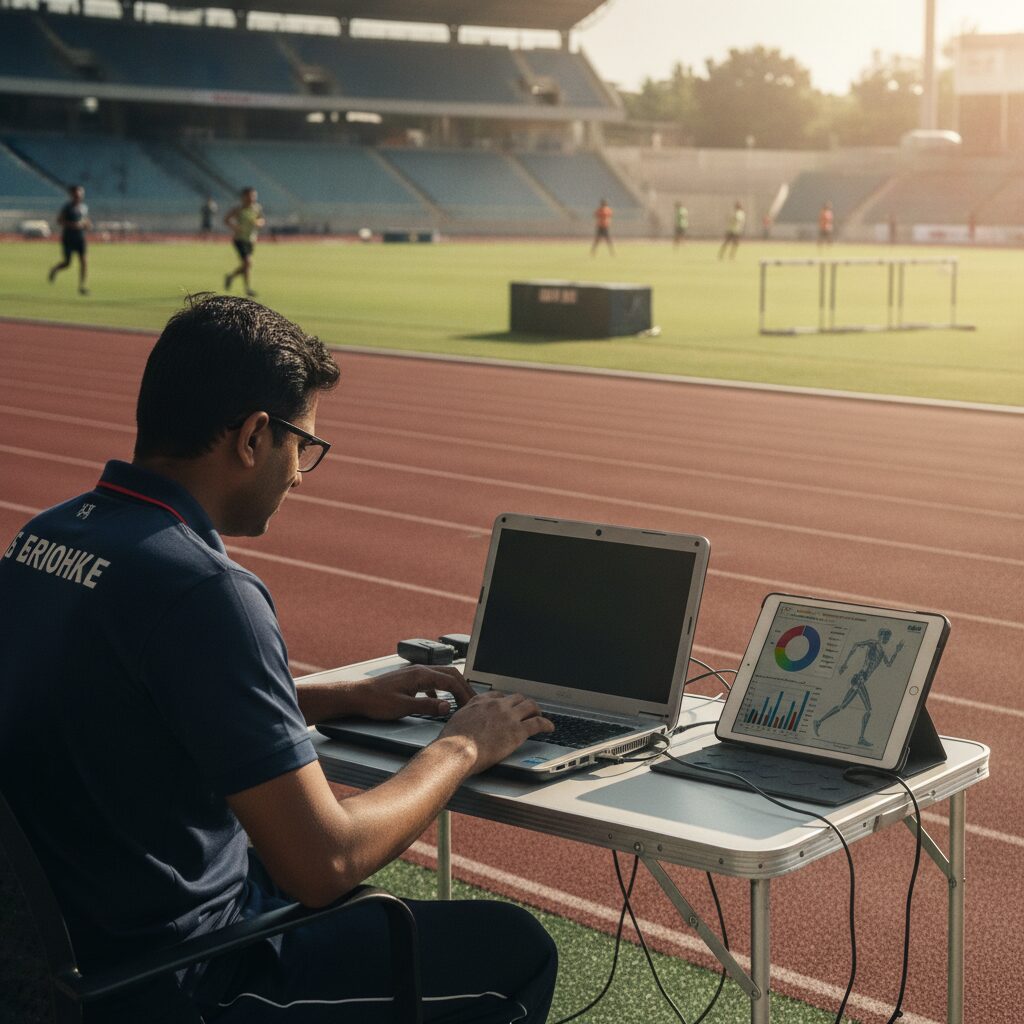
This structural change explains why third-party consulting dominates the sports analytics market india. A market study published on 28 September 2026 by IMARC Group shows that the Indian sports data sector reached $65.06 million in valuation, with forecasts pointing toward $199.31 million by 2034 at a compound annual growth rate of 15.02%. The report highlights that third-party analytics services account for 55% of total market revenue. Sports enterprises are paying for ready expertise instead of custom lines of software code.
The economics behind the 65 million dollar valuation
Software development in sport carries substantial overheads that domestic teams struggle to justify. Building proprietary athlete tracking systems, video tagging interfaces, and predictive draft models requires dedicated software architects, database administrators, and cloud hosting infrastructure. In practice, a mid-tier cricket franchise or Indian Super League football club spending ₹15,00,000 to ₹30,00,000 annually on engineering maintenance gets tied to obsolete code within two seasons. When sports technology changes quickly, fixed internal assets turn into balance-sheet liabilities.
Specialized data consultancies absorb these platform development costs across dozens of international and domestic clients. An outsourced provider can update its computer-vision tracking tools and deliver customized tactical dashboards for a fraction of what an academy would spend on in-house engineers. Data agencies deliver immediate domain knowledge during short competitive windows, such as the two-month auction cycles in franchise cricket and kabaddi. Clubs gain institutional capabilities during active tournaments without sustaining heavy payrolls through eight months of off-season downtime.
Why services claim 55 percent of India sports data spending
Data without strategic interpretation creates operational friction rather than competitive advantages. Coaches and performance directors rarely want raw telemetry files or unwieldy relational databases after a fixture. They want direct tactical answers to precise match questions: which opening batter struggles against left-arm pace on dry wickets, or how a defender holds spatial shape during high-tempo pressing sequences. The value lies in translating numeric tables into field drills, substitution timings, and defensive assignments.
According to research from IMARC Group, service-oriented agencies control over half the industry because Indian athletic departments prioritize immediate domain interpretation. When our team works with aspiring analysts through the Distance Diploma in Sports Analytics (DDSA) at ISST, we witness this division firsthand. Franchises do not lack data feeds. They lack translators who can sit across from a head coach, defend statistical findings, and suggest training modifications without using technical programming language.
The profile of modern sports consultancy in India
Third-party sports data firms operating in Bengaluru, Mumbai, and Delhi have developed structured service delivery models. Instead of licensing a generic software subscription, these firms sell outcome-focused consultancy packages designed for specific sports verticals:
- Tactical scouting and opposition profiling delivered 48 hours before match fixtures
- Auction intelligence models that calculate replacement value versus player auction price
- Load monitoring audits coordinated with strength coaches to reduce soft-tissue strains
- Broadcast data feeds engineered to supply real-time statistical graphics to television producers
Each service relies on client-facing analysts who bridge quantitative methodology and pitch-level tactics. ISST alumni connect profiles, like that of Anirban Dutta working at video analysis firm HUDL India, illustrate how practitioners build long-term careers by pairing technical tagging skills with practical communication. Sports consultancies need specialists who understand both athletic nuance and client relationship management.

Bridging athlete numbers and legal governance
Outsourcing athlete performance metrics creates serious compliance questions regarding ownership and personal privacy. Indian federations and academies collect continuous telemetry data, including heart rate variability, sleep patterns, and precise biometric markers during regular drills. When teams rely on external vendors to process these data streams, clear protocols must govern data custody and storage.
Students examining regulatory sports management must study the legal boundaries of performance tracking. A detailed review of sports data privacy in India demonstrates that athletes are beginning to question who retains ownership over their physical metrics once their employment contracts expire. Service agencies that handle proprietary squad intelligence must maintain strict internal data architecture to prevent breach of contract or accidental data leaks to rival franchises.
How young professionals position for client-facing sports data roles
Breaking into sports data consultancy requires a different preparation pathway than standard corporate software engineering. Knowing how to write basic SQL queries or scrape Python datasets is only a baseline qualification. To earn a client-facing position at a sports advisory firm, young practitioners must master three distinct competency areas.
First, develop sport-specific tactical literacy through formal sports education. You must understand field formations, recovery physiology, and match strategy before your statistical analyses will carry weight with high-performance coaches. Many aspiring analysts study academic frameworks through our BSC Sports Management or specialized diplomas to grasp the commercial and technical realities of team sports.
Second, build public-facing case studies rather than private GitHub code repositories. Instead of writing abstract algorithms, produce an analysis of bowling lengths in death overs or defensive transitions in regional football tournaments. Present the findings as a mock advisory brief for an executive board, highlighting risks, player strengths, and actionable tactical solutions.
Third, gain practical training in client management and live reporting. Consulting firms test candidates on how well they explain probabilistic metrics under pressure. During real-world projects at the ISST High Performance Centre, our students review athlete data alongside physiotherapists and conditioning coaches. This live exposure teaches candidates how to deliver feedback constructively without alienating the technical staff responsible for player welfare. For detailed curriculum options and career routes, consult our comprehensive sports analytics career guide.
Educational pathways into sports consultancy
A career in sports data requires a structured academic grounding that combines statistical methodology, operational sports management, and exercise science. Employers in the sports analytics market india seek well-rounded professionals who grasp the commercial frameworks of competitive athletics, not just coding fundamentals.
At the Institute of Sports Science & Technology (ISST), classroom and distance programmes equip candidates with practical domain expertise. Our UGC recognized degree programmes ensure that graduates meet national academic benchmarks while completing practical training in sports performance facilities. By combining video analysis tools, data interpretation, and sports business strategy, students develop the analytical mindset required by high-growth consultancy agencies across the country.
Frequently Asked Questions
What is driving the growth of sports analytics in India?
Commercial sports leagues, grassroots development programs, and growing private investments create strong demand for data-backed player scouting and training optimization. High financial stakes in athlete auctions and broadcast rights encourage teams to rely on verified statistical performance metrics.
Why do Indian sports clubs outsource their analytics operations?
Outsourcing allows clubs to access specialized technology and experienced analysts during active seasons without funding year-round software development teams. Third-party consulting agencies provide immediate tactical solutions and cost certainty through competitive tournament schedules.
What skills are essential for sports data consultancy roles?
Practitioners must combine technical skills like SQL and Python with clear verbal communication and sport-specific tactical understanding. The ability to translate abstract numeric models into practical coaching advice is the decisive factor during hiring evaluations.
What degree is best for a sports analytics career in India?
A degree in sports management or sports sciences paired with specialized certifications in sports analytics provides the ideal educational foundation. Accredited programs ensure candidates understand high-performance training methods alongside commercial league operations.
How much is the Indian sports analytics market expected to grow?
According to an IMARC Group report published on 28 September 2026, the market will expand from $65.06 million to $199.31 million by 2034. This expansion represents a steady compound annual growth rate of 15.02% across hardware, software, and consulting sectors.
Do sports data consultants work directly with athletes and coaches?
Client-facing consultants present opposition intelligence, tactical match briefings, and fatigue reports directly to head coaches, team managers, and conditioning staff. They attend planning meetings to help coaching groups set objective performance benchmarks before competitive matches.
What industries employ sports data analysts in India?
Professional franchises, sports technology firms, national sports governing bodies, athletic apparel brands, and broadcast media networks regularly hire trained analysts. Private sports academies and performance testing laboratories also employ consultants to track grassroots athletic progress.
Can I transition into sports analytics from an engineering or business background?
Graduates with quantitative backgrounds in business or computing can enter the industry by acquiring formal sports domain knowledge through postgraduate diplomas. Learning athletic rules, performance physiology, and league business operations bridges the gap between general analytics and sports practice.
Now that India Sports Analytics Market Climbs to $65.06 Million in 2026 with Services Sector Holding 55% Market Share, position yourself for elite sports consultancy roles with ISST. Explore our accredited degree and diploma programmes, book a free academic counselling session today with no upfront commitment, and build your career in sports analytics.
The Institute of Sports Science & Technology (ISST), founded in 2008 in Pune, is India’s premier education center dedicated exclusively to sports management and sports science. By integrating cutting-edge academic pedagogy, robust industry partnerships, and scientific methodologies, ISST develops top-tier professionals equipped to lead the modern sports, fitness, and wellness industries.
- Founded in 2008 as a pioneer in Indian sports education
- Offers specialized programs in Sports Management & Sports Science
- Strong industry partnerships with leading sports leagues, teams, and organizations
- Faculty comprises expert sports scientists, veteran coaches, and industry researchers
- Dedicated placement cell with extensive national and international support