

The shift from gut feel to data baselines
For decades, talent scouting in India relied on the ‘eye test’. A coach would watch a teenager play in a rural tournament, trust their intuition, and decide if the kid had ‘it’. This method is prone to bias. It favors athletes who are early bloomers or those who happen to play in front of the right scout at the right time.
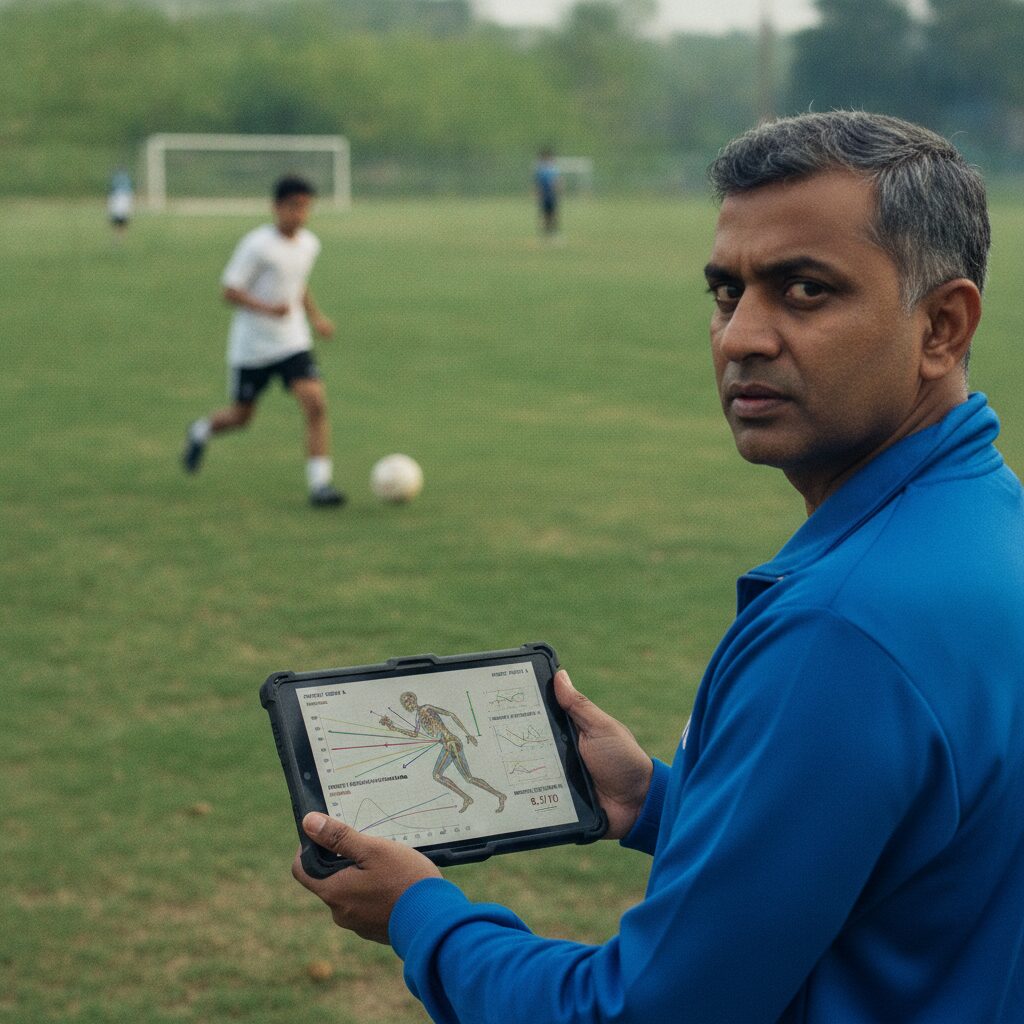
Indian academies are now moving toward AI-driven identification. This is different from match analytics. While match analytics tell you how a player performed in a game, AI talent scouting looks for raw, latent potential. It identifies the physical and kinematic markers that correlate with elite success, often before the athlete has even mastered the technical skills of the sport.
In our work at ISST (Institute of Sports Science & Technology), we have seen that the most successful programs no longer ask if a player is good today. They ask if the player’s biomechanical profile suggests they can be elite in four years. This shift is essentially moving from descriptive data to predictive modeling.
Identifying raw potential through computer vision
Computer vision is the primary tool for modern athlete identification. Instead of relying on a scout’s notes, academies use high-speed cameras and AI to track joint angles and center-of-mass movement. This allows them to measure explosive power and agility with precision that the human eye cannot match.
When you run these tests, the AI doesn’t look at the score of the game. It looks at the kinematics of a sprint or the rotation of a shoulder during a throw. According to a 2026 analysis of youth athletic benchmarks, AI can identify ‘outlier’ physical traits in 14-year-olds that traditionally wouldn’t be noticed until they were 17. This gives academies a three-year head start in training.
For example, a young cricketer might have a clumsy bowling action but possess a specific hip-to-shoulder separation ratio that is common among fast bowlers. A human coach might overlook the player due to the poor technique. The AI flags the biometric potential. This is why understanding sports technology is now a requirement for any serious scout.
Predictive growth modeling and biometric baselines
The failure mode of traditional scouting is the ‘relative age effect’. Children born earlier in the selection year often appear more talented simply because they are physically more mature. AI removes this noise by using predictive growth modeling. It compares a child’s current metrics against thousands of historical growth curves.
Machine learning algorithms can now predict an athlete’s adult height, muscle fiber composition, and aerobic capacity with high accuracy. By normalizing data against age and maturity levels, academies can find the ‘late bloomer’ who is currently smaller than their peers but possesses the physiological markers of a future champion.
In practice, this means an academy can justify investing in a player who is currently underperforming but has a high ‘potential ceiling’. This objective evidence reduces the financial risk for the academy. It transforms scouting from a gamble into a calculated investment in human capital.
Democratizing talent discovery in rural India
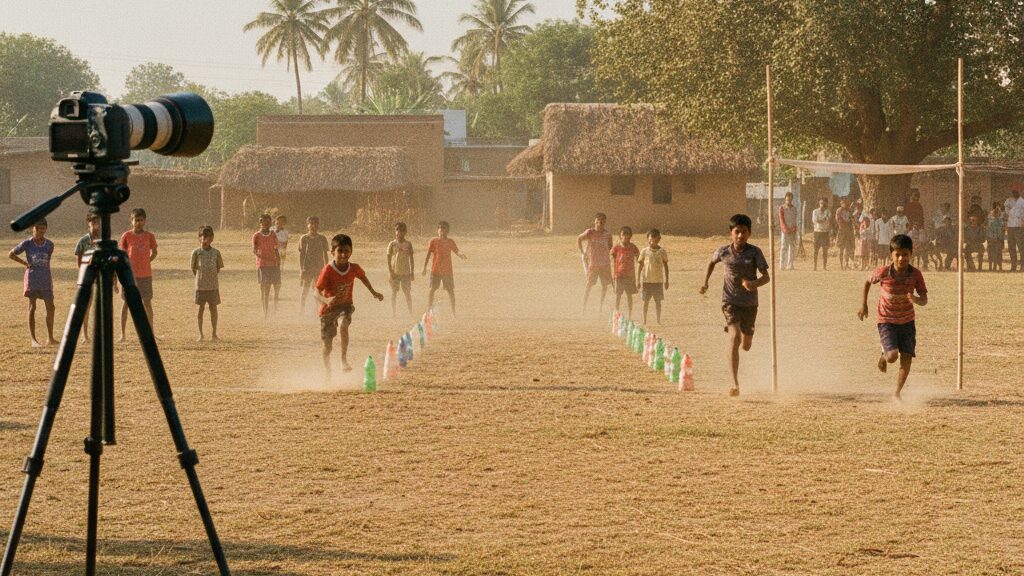
India’s biggest challenge is its geography. Elite scouts cannot visit every village in Haryana or every coastal town in Kerala. Mobile-based AI tools are solving this. Athletes can now record specific movement drills on a smartphone, and AI cloud platforms analyze the video for athletic markers.
This creates a digital funnel. A child in a remote village can upload a video of a vertical jump or a 20-meter sprint. The AI filters these uploads to find the top 1% of physical outliers. Scouts then only travel to meet the athletes who have already cleared the biometric threshold.
This system ensures that talent is found based on merit, not access. It aligns with the goals of programs like the BSc Sports Science, where the focus is on the scientific quantification of human performance to optimize athlete pathways.
The role of the human expert in an AI world
There is a common fear that AI will replace the scout. This is a misunderstanding of how the technology works. AI is excellent at identification, but it is poor at evaluation. It can tell you that a player has the hip mobility of a world-class athlete, but it cannot tell you if that player has the mental resilience to handle a high-pressure final.
The most effective scouting models use a ‘hybrid’ approach. The AI acts as the filter, narrowing down a pool of thousands to a few dozen. The human scout then steps in to evaluate the psychological and social factors. This is where the principle of authority comes in. A scout’s experience is used to validate the AI’s findings, not to compete with them.
Professionals who can bridge this gap—those who understand both the data and the human element—are in high demand. This is the core objective of the Distance Masters Programme in Sports Sciences (DMPSS), which trains practitioners to use science to drive sporting decisions.
Implementing AI scouting: the practical steps
Academies starting with AI usually follow a three-step implementation. First, they establish a biometric baseline for their current athletes. Second, they use computer vision tools to screen new recruits. Third, they feed the results of these recruits’ progress back into the ML model to refine the predictive accuracy.
The result is a self-improving system. The more athletes an academy scouts, the better the AI becomes at predicting who will actually s쳮d. This creates a competitive advantage that is nearly impossible to overcome once established. Academies that rely solely on traditional methods are effectively operating with a blind spot.
When you see the data, the conclusion is clear. AI doesn’t just find better athletes; it finds them faster and with less waste. The future of Indian sports isn’t just about harder training, but about smarter identification.
Frequently Asked Questions
Does AI replace the need for human scouts?
No, it acts as a filter. AI identifies raw physical potential, while human scouts evaluate mental toughness and character.
How is AI scouting different from match analytics?
Match analytics evaluate performance during a game. AI scouting identifies latent biometric traits that predict future potential.
Can AI identify talent from smartphone videos?
Yes, computer vision can analyze kinematics and joint angles from standard video uploads to flag athletic outliers.
What is the relative age effect in scouting?
It is the bias where older children in a peer group seem more talented due to physical maturity. AI corrects this by normalizing data.
Is AI scouting expensive for small academies?
Costs are dropping as cloud-based AI tools move to subscription models, making them accessible to smaller regional centers.
Which biometric markers does AI look for?
It tracks things like hip-shoulder separation, explosive power, and center-of-mass efficiency during movement.
Can AI predict an athlete’s adult height?
Yes, by using ML to compare current growth patterns against large datasets of historical athletic growth curves.
What degree helps in learning AI scouting?
Degrees in Sports Science or specialized diplomas in Sports Technology provide the necessary foundation in biomechanics and data.
Build a professional career in sports science today. Explore our certified programs to master the tools of modern athlete identification with no admission fee for initial counseling.