

Explore the top 10 richest sports leagues in the world for 2026. Compare NFL, IPL, NBA, and EPL annual revenue, media deals, and per-match valuations.
Wealth in sports is no longer about the size of the stadium. It is about the reach of the signal. In June 2026, the global sports economy has decoupled from local attendance. Money flows toward the leagues that own the most attention, not the most seats. The industry has evolved from simple ticket sales into a high-margin digital media economy. Professional sports now operate as tech-integrated entertainment conglomerates. This guide breaks down the financial health of the highest revenue sports leagues, focusing on how media rights and global expansion drive these billion-dollar valuations. Figures below come from the sources linked in each section and were reviewed in September 2026. For students pursuing a BBA in sports management at ISST, understanding these economic levers is the first step toward building a career with real leverage.
Capital follows scarcity. In a world of infinite content, live sports are the last remaining scarce resource. This scarcity allows leagues to command prices that seem irrational to the uninitiated but are perfectly logical to the networks. When you look at the salary of sports manager in IPL 2026, you are seeing a small fraction of a massive value capture. The richest leagues have mastered the art of turning a physical game into a digital asset. They sell the same match multiple times across every time zone on earth.
2026 Rankings: The Richest Sports Leagues in the World by Revenue
While the NFL and IPL dominate the conversation in terms of sheer volume and growth rate, a complete picture of the richest sports leagues in the world requires looking at the established giants of North America and Europe. In 2026, the financial hierarchy is defined by a mix of domestic monopoly and global brand equity.
- Major League Baseball (MLB): Remains a powerhouse through massive local media markets and a high volume of games, with league revenue reported at a record $12.1 billion for the 2024 season.
- NBA (National Basketball Association): Leveraging a younger, more global demographic, the NBA has scaled its revenue through international expansion and media deals, with teams generating about $12.25 billion in 2024-25.
- English Premier League (EPL): The wealthiest football league, with clubs generating £6.8 billion in 2024/25, according to Deloitte, helped by a strong global broadcasting deal.
The critical difference between these leagues is their revenue composition. While MLB relies on volume, the NBA and NFL rely on scarcity and high-value media rights. For those studying sports management, analyzing these different models reveals how different sports scale based on their inherent ‘watchability’ and global appeal.

The Full Global Hierarchy: Expanding the Top 10 Richest Sports Leagues
While North American giants and the English Premier League command top headlines, a complete evaluation of the richest sports leagues in the world requires analyzing the financial powerhouses rounding out the global top ten:
- National Hockey League (NHL): Generating over $6.8 billion annually across 32 teams in the US and Canada, the NHL relies heavily on robust local ticketing, sponsorship integrations, and long-term national broadcast contracts with ESPN and TNT.
- La Liga (Spain): Bringing in approximately €5.4 billion ($5.9 billion), Spanish football is anchored by the commercial might of Real Madrid and FC Barcelona, which continuously generate historic non-matchday retail and global sponsorship revenues.
- Bundesliga (Germany): Generating roughly €4.3 billion ($4.7 billion), Germany’s top tier boasts the world’s highest average stadium attendances alongside disciplined commercial frameworks governed by the 50+1 fan ownership model.
- Serie A (Italy): With annual revenues surpassing €3.9 billion ($4.2 billion), Italian football has leveraged modernized overseas broadcast contracts and private equity capital injections into domestic stadium modernization projects.
- Formula 1: Operating on a unique traveling championship model, F1 generates over $3.4 billion through promoter fees, multi-year paddock club hospitality agreements, and high-margin global streaming subscriptions via F1 TV and global broadcast syndication.
For aspiring executives, these diverse frameworks demonstrate that sports monetization is not one-size-fits-all. While European leagues balance domestic matchday tradition with international licensing, motorsports monetize global spectacle and corporate hospitality.

Global Leaderboard: Richest Sports Leagues at a Glance
To understand the financial landscape of professional sports, we must look at the numbers. The NFL leads on total revenue. The IPL is shown as a valuation because it is not directly comparable with revenue figures: it is a valuation of the league as a business, not annual revenue. Figures cover different reporting periods, so use the table for scale rather than an exact ranking.
| League | Latest reported figure | Basis | Primary revenue driver |
|---|---|---|---|
| NFL (USA) | Over $20 billion (estimated) | Total revenue; national revenue alone topped $14 billion in 2025 | National media rights |
| NBA (USA) | $12.25 billion | Team revenue, 2024-25 (Sportico) | Media rights and sponsorship |
| MLB (USA) | $12.1 billion | League revenue, 2024 (CBS Sports) | Local and national media |
| English Premier League (UK) | £6.8 billion | Club revenue, 2024/25 (Deloitte) | Broadcast and commercial |
| IPL (India) | $20.6 billion | Enterprise value (a valuation, not revenue), 2026 (Houlihan Lokey) | Media rights and franchise value |
This hierarchy demonstrates a clear divide between ‘monopoly models’ (NFL/MLB) and ‘expansion models’ (IPL/NBA). For students of sports management, the key takeaway is that the richest sports leagues in the world are no longer just athletic competitions—they are IP holding companies that license content to the highest bidder.

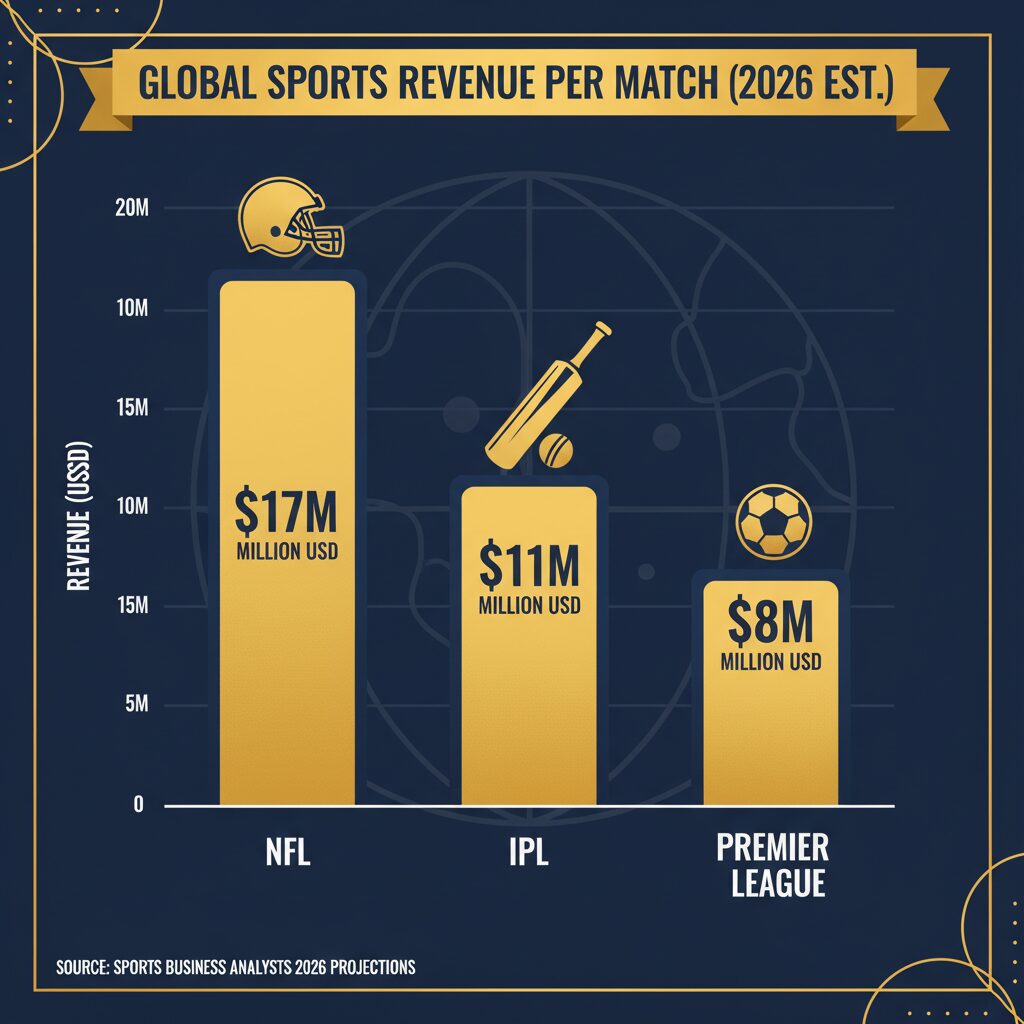
Total Revenue vs. Revenue Per Match: Why the IPL Defies Traditional Metrics
When measuring the richest sports leagues in the world purely by total annual turnover, leagues with 82-game (NBA), 162-game (MLB), or 380-match (EPL) calendars naturally accumulate higher gross numbers. However, dividing annual revenue by total matches played reveals a radically different balance of power.
On a per-match revenue basis, the Indian Premier League (IPL) commands over $15 million per match in media rights and domestic broadcast distribution alone. This metric places cricket’s premier showcase second only to the NFL, which generates roughly $36 million per broadcasted game across its compact 272-game regular schedule.
- NFL: ~$36 million per game (Scarcity model: 17 regular-season games per team).
- IPL: ~$15.5 million per match (Condensed window: 74 matches across 60 days).
- English Premier League: ~$11 million per match (Sustained weekly volume: 380 total fixtures).
- NBA: ~$3.2 million per game (High inventory: 1,230 regular-season fixtures).
- MLB: ~$1.8 million per game (Mass inventory: 2,430 regular-season fixtures).
Understanding this efficiency metric explains why private equity firms and sovereign wealth funds aggressively target condensed tournament formats. Leagues that capture high per-minute attention create immense ad-slot bidding density without player fatigue.

NFL Revenue 2026: Analysis of the World's Richest Sports League
The NFL is privately run and does not publish audited league accounts, so revenue figures come from media reporting. Sportico reported that national revenue (media rights and league-wide sponsorships) topped $14 billion in 2025, more than $450 million for each of the 32 teams, with total league revenue estimated above $20 billion once local revenue is included. The NFL operates as a media company that happens to play football. Its revenue model relies on long-term certainty: by locking in multi-year broadcast deals, it has insulated itself from much of the volatility of the wider economy.
The league’s leverage comes from its monopoly on Sunday attention, which it has used to extract high fees from both traditional broadcasters and technology companies.
Broadcast rights and the streaming shift
Broadcast rights are the engine. The NFL sells broadcast rights worth roughly $10 billion a year, and streamers are now real buyers: Amazon pays around $1 billion a year for Thursday Night Football, Netflix has bought Christmas Day games, and YouTube holds Sunday Ticket, according to industry reporting. This shift creates demand for a new type of professional who understands data rights, digital advertising and global IP law. It is also why we cover AI and wearable technology in sports science in our programmes. Algorithms are shaping the game as much as the athletes are.
The Anatomy of Wealth: How the Richest Leagues Scale Revenue
Wealth in the top tier of sports leagues is derived from three primary pillars. Understanding the ratio between these pillars is what separates a sustainable league from a speculative bubble.
- Media Rights (The Engine): Broadcasting is the largest single stream for many leagues. For Premier League clubs it was £3.4 billion of £6.8 billion in 2024/25, roughly half of total revenue (Deloitte).
- Commercial & Sponsorships (The Accelerator): Commercial revenue was the fastest-growing Premier League stream, up 13% to £2.4 billion in 2024/25 (Deloitte). Brands increasingly buy access to fan data and digital experiences, not just a logo on a jersey.
- Match-Day & Hospitality (The Foundation): Premier League matchday revenue passed £1 billion for the first time in 2024/25 (Deloitte), showing that premium stadium experiences remain lucrative.
The most successful leagues are those that have decoupled their revenue from the physical constraints of the stadium. By transforming a 90-minute match into a 24/7 content cycle, they ensure a constant stream of micro-transactions and subscription fees.

IPL Valuation 2026: The Rapid Rise of Cricket's Richest League
How the IPL became a $20 billion business
The IPL is no longer just a regional success story. Houlihan Lokey’s 2026 valuation study put the IPL’s enterprise value at $20.6 billion, up 11.4% year on year, the second consecutive year of double-digit growth. Its standalone brand value was estimated at $4.3 billion. This growth is fuelled by a large domestic market and a diaspora that consumes content on mobile-first platforms.
The 2023–2027 media rights cycle was the first in which digital rights were sold for more than television rights, a sign that India is a digital-first sports economy. If you want a career in sports, the IPL is the centre of gravity for the eastern hemisphere.
Value per match: Comparing IPL to the global elite
The metric that matters here is value per match. Houlihan Lokey notes that, on a per-match basis, only the NFL ranks ahead of the IPL globally. The season is short, roughly two months, yet it carries value that rivals leagues playing for far longer. This is density: every match is an event, with few ‘meaningless’ mid-season games. For a sports manager, that means every operational decision has a higher impact on the bottom line, which is why practical training matters. You have to be ready to manage high-pressure environments.
The Scaling Blueprint: How the Richest Leagues Multiply Value
The title of this report asks how these leagues scale. Scaling in professional sports is no longer about adding more teams; it is about increasing the average revenue per fan across territories. The richest leagues tend to follow a two-part scaling approach:
- Vertical Integration of Media: Moving from selling rights to third-party networks to launching proprietary streaming platforms. This allows leagues to own the first-party data of their fans.
- Geographic Expansion: Exporting the ‘product’ to markets with high disposable income. The NBA’s international games and the Premier League’s overseas broadcast deals are examples.
Understanding this framework is essential for any professional aspiring to enter the front office. The transition from a ‘sports fan’ to a ‘sports executive’ happens when you stop looking at the score and start looking at the scalability of the intellectual property.

European football and the battle for highest revenue sports leagues
English Premier League dominance in the 2025–2026 season
The English Premier League (EPL) remains the wealthiest football league. Deloitte reports that Premier League clubs generated £6.8 billion in 2024/25, up 8% on the previous season, made up of £3.4 billion broadcast, £2.4 billion commercial and over £1 billion matchday revenue. Unlike the NFL, which is a domestic giant, the EPL is a global export, with international broadcast rights a major part of its strength.
But the league faces pressure. Player wages and transfer fees take a large share of income, and clubs increasingly need commercial, data and finance specialists to find efficiencies in scouting and partnerships. That is the space our PG Diploma in Sports Management is designed for.
The UEFA Champions League new format financial impact
UEFA’s distribution circular for 2025/26 set gross revenue for the Champions League, Europa League, Conference League and Super Cup at €4.4 billion, with about €2.47 billion going to Champions League clubs. The expanded 36-team league phase created more matches, and more ‘inventory’ to sell. Domestic leagues and player groups have raised concerns about fixture load, so managing the tension between quantity and quality is a key challenge for football executives. It requires an understanding of sports science and athlete recovery, which we cover in our Masters Programme in Sports Sciences.
North American giants: MLB and NBA financial metrics
NBA global licensing and the 2026 jersey sponsorship market
NBA teams generated about $12.25 billion in 2024-25, and Sportico projected $14.3 billion for 2025-26. The NBA’s strategy is built on individual stardom, and marketing its players well drives licensing and merchandise revenue. Sponsorship has also grown, including jersey patches.
Major League Baseball regional sports network evolution
MLB reported record revenue of $12.1 billion for 2024. One challenge has been the decline of traditional Regional Sports Networks (RSNs). MLB has responded by taking over local broadcasts for some teams and selling games direct to fans, which gives the league more control over fan relationships and data.
Current sports industry growth statistics and 2026 trends
The rise of sports betting integration in league revenue
Betting sponsorships and data partnerships have become a growing revenue line for many leagues, though the size varies widely by country and regulation. In India, the regulatory environment is different from the US and UK, which is why legal and compliance skills matter. For managers, ethical management and integrity of play are top priorities.
Teams and leagues also use analytics tools to predict fan behaviour and optimise ticket pricing, so data literacy is increasingly part of a sports management career.
Direct-to-consumer (DTC) streaming models as revenue drivers
Leagues are cutting out the middleman. By building their own platforms, they keep more of the revenue and the first-party fan data. ‘NBA League Pass’ and ‘F1 TV’ are the templates. The challenge is the high cost of customer acquisition. You aren’t just competing with other sports; you are competing with Netflix and TikTok for the user’s finite time.
How sports education powers these multi-billion dollar leagues
The demand for specialized sports management professionals
As the numbers get bigger, the room for amateurs disappears. A multi-billion dollar league cannot be run by former players alone. It requires specialists in finance, law, marketing, and technology. Demand for trained sports management professionals is growing in markets like India.
At ISST, we bridge this gap. Our BBA in Sports Management gives you the specific knowledge needed to navigate this economy. We don’t just teach theory; we provide live exposure through our industry partnerships. You learn by doing.
ISST Alumni Connect: Bridging the gap to global leagues
Through the ISST Alumni Connect programme, current students can learn from alumni working across the sports industry. Visit the ISST website for current alumni stories and placement details.
Frequently Asked Questions
Which is the richest sports league in the world?
The NFL, with estimated total revenue above $20 billion, according to media reporting. National revenue alone (media rights and league-wide sponsorship) topped $14 billion in 2025.

What is the IPL valuation in 2026?
Houlihan Lokey valued the IPL’s enterprise value at $20.6 billion in 2026, up 11.4% on the previous year. Convert to rupees at the exchange rate on the day you check.
Is the IPL’s valuation the same as its revenue?
No. Enterprise value is what the league is worth as a business. Revenue is what it earns in a year. The two are not interchangeable, so do not compare an IPL valuation directly with NFL or NBA revenue.
Is the Premier League wealthier than the NBA?
On the latest figures, no in absolute terms: NBA teams generated about $12.25 billion in 2024-25, while Premier League clubs generated £6.8 billion in 2024/25. The Premier League is the richest football league.
How much money does the Champions League make?
UEFA set gross revenue for its 2025/26 club competitions at €4.4 billion, with about €2.47 billion distributed to Champions League clubs.
Where does Premier League revenue come from?
In 2024/25, £3.4 billion came from broadcasting, £2.4 billion from commercial deals and over £1 billion from matchday income, according to Deloitte.
How much does the NFL earn from media rights?
The NFL sells broadcast rights worth roughly $10 billion a year according to industry reporting, with streamers such as Amazon, Netflix and YouTube now among the buyers.
What jobs exist in sports league finance and management?
Leagues employ specialists in media rights, sponsorship sales, analytics, legal and operations. See our guide to sports manager salaries in the IPL for career context.
Looking for what players earn rather than what leagues earn? See our guide to the highest paid sports leagues.
The financial landscape confirms that data-driven management is increasingly central to running a league. From the NFL’s media dominance to the IPL’s staggering growth, the industry demands specialists. At ISST, we provide the practical training and live exposure you need to excel. Whether your interest lies in sports sciences or management, the path to a high-leverage career starts with industry-aligned education. Explore our UGC recognised programmes and book a free counselling session to plan your route into the industry.
The Institute of Sports Science & Technology (ISST), founded in 2008 in Pune, is India’s premier education center dedicated exclusively to sports management and sports science. By integrating cutting-edge academic pedagogy, robust industry partnerships, and scientific methodologies, ISST develops top-tier professionals equipped to lead the modern sports, fitness, and wellness industries.
- Founded in 2008 as a pioneer in Indian sports education
- Offers specialized programs in Sports Management & Sports Science
- Strong industry partnerships with leading sports leagues, teams, and organizations
- Faculty comprises expert sports scientists, veteran coaches, and industry researchers
- Dedicated placement cell with extensive national and international support