The invisible economy of Indian gaming
Most people see a teenager with a headset and a high-end PC. They see a hobby. But if you look at the numbers, you see a massive, professional industry that operates differently than any traditional sport. By August 2026, the Indian esports market has shifted from a niche interest to a primary entertainment driver. According to the 2026 India Gaming Report, the domestic esports ecosystem is valued at approximately ₹28,000 crore, with a viewer base that exceeds the combined reach of several traditional professional leagues.
This growth creates a problem. We have thousands of passionate gamers and a handful of star athletes, but we lack the professional managers to run the show. The industry is currently operating on trial and error. Most teams are managed by former players who know how to play the game, but not how to build a sustainable business. This is where the need for a dedicated esports management course in India becomes urgent.
Why traditional sports degrees miss the mark
Traditional sports management focuses on stadiums, ticketing, and physical venue logistics. While these are important, they are secondary in the digital arena. In esports, the stadium is a Twitch stream or a YouTube Live event. The ticket is a digital subscription or a skin purchase. The logistics are about server stability and latency, not parking lots and concession stands.
In our work at ISST (Institute of Sports Science & Technology), we have seen that graduates of general sports degrees often struggle with the speed of the digital economy. Traditional degrees teach you how to manage a football club’s season. Esports management requires you to manage a game’s patch update that can change the entire competitive meta overnight. The volatility is higher. The audience is younger. The revenue streams are completely different.
The anatomy of a digital-first specialization
An effective esports management course must move beyond the surface. It cannot just be about “gaming.” It must be about the business of attention.
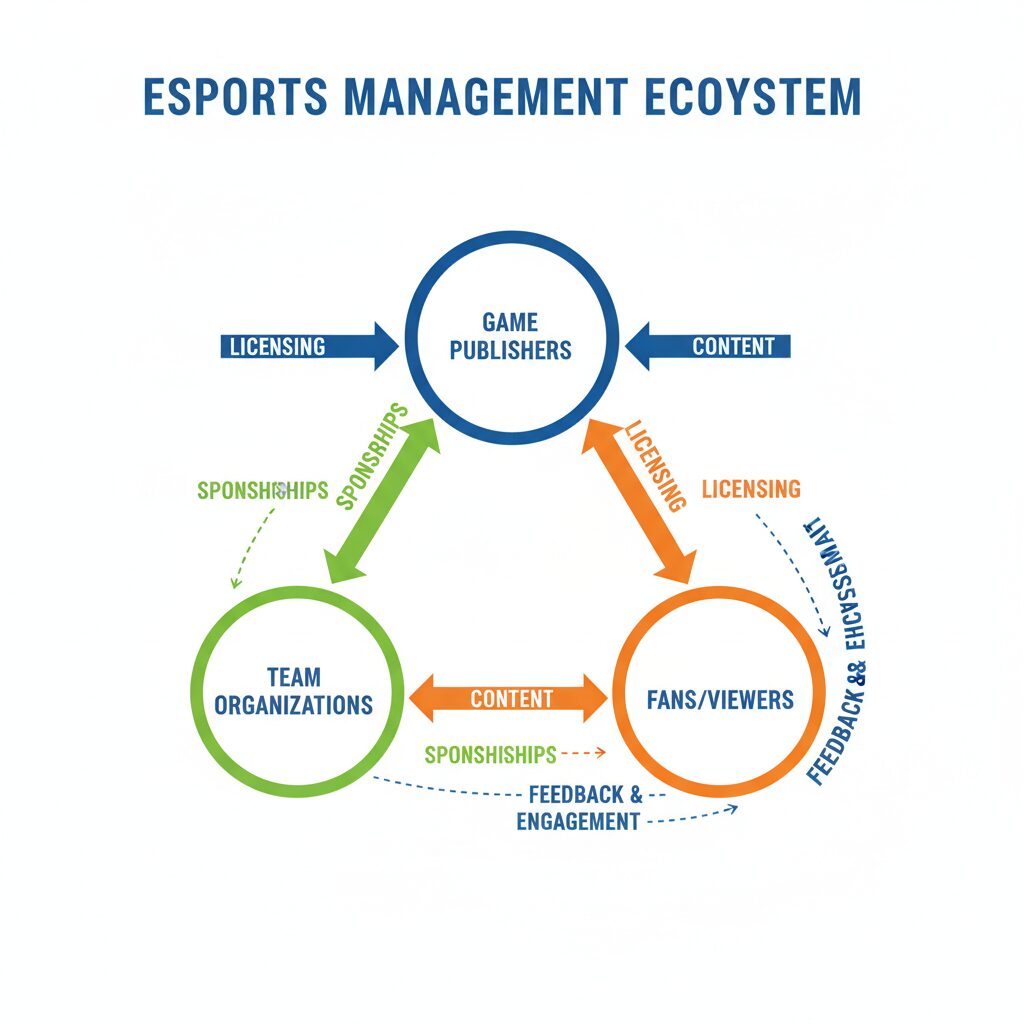
One key area is Digital Asset Management. Unlike a physical jersey, an esports team’s value often lies in its digital presence and the intellectual property of its players’ brands. Managing these requires a mix of legal knowledge and digital marketing.

Another critical pillar is Tournament Operations. Running a LAN event in India requires a specific set of skills. You are managing high-bandwidth infrastructure while coordinating with game publishers who hold all the power. The failure mode here is usually a lack of technical foresight. If the internet drops for ten seconds during a grand final, the entire event’s credibility vanishes. A trained manager knows how to build redundancy into the system.
Career paths in the new sports economy
People often think a career in esports means being a “coach.” That is a small fraction of the market. The real opportunity lies in the operational side.
League Operations Manager
These professionals design the rulebooks. They ensure fair play and manage the schedule. They are the architects of the competition. In a market as fragmented as India, the ability to standardize rules across different regions is a high-value skill.
Talent Manager
Esports athletes are young and often lack financial literacy. A talent manager does more than book sponsorships; they protect the athlete’s career. This involves managing burnout and ensuring the player’s brand remains viable after they stop competing.
Brand Partnership Strategist
Brands are no longer just buying logo placements. They want integrated content. According to 2026 sponsorship data, integrated content placements in esports yield 40% higher engagement than traditional banner ads. Strategists who can bridge the gap between a corporate brand and a gaming community are in high demand.
Bridging the gap with the ISST eSports Centre
At ISST, we recognized that you cannot learn this from a textbook alone. This is why we established the ISST eSports Centre. Practical training is the only way to understand the pressure of a live broadcast or the complexity of a team contract.
When you combine this with a broader foundation, such as a Distance Masters Programme in Sports Management (DMPSM), you get a professional who understands both the old world and the new. You gain the academic rigor of a recognized degree and the tactical agility of an esports specialist. This duality is what makes a candidate employable in the current market.
The psychological shift in sports education
If you want to s쳮d in this space, you have to stop thinking of esports as a subset of sports. Think of it as the intersection of sports, entertainment, and technology. The people who win in this industry are those who can apply the principles of authority and social proof to build communities.
For example, look at how successful Indian gaming orgs build their fanbases. They don’t just post scores. They create narratives. They use the “bandwagon effect” by aligning themselves with trending games and high-profile influencers. A manager trained in these psychological triggers can grow a team’s following far faster than someone using a traditional marketing playbook.
Distance vs Classroom: Choosing your path
For many, the choice between a classroom degree and a distance program comes down to their current involvement in the industry.
Students who are completely new to the field often benefit from the immersion of a classroom environment. They get immediate feedback and networking opportunities. However, for those already working in the gaming space or managing a small team, distance education is more practical. It allows them to apply a lesson on sponsorship on Monday and see the results in their own project by Tuesday.
Comparing these two models is a common point of debate. We have analyzed this in our recent study on Blended vs Distance Sports Degrees, where we found that the most successful learners are those who can integrate their academic study with real-world application in real-time.
The long-term outlook for Indian esports professionals
By 2030, the distinction between “sports” and “esports” will likely disappear. They will both simply be “competitive entertainment.” Those who enter the field now as specialists will be the senior executives of the next decade.
But there is a risk. The industry moves so fast that a degree can become obsolete if it only teaches tools and not principles. The goal of a high-quality esports management course is not to teach you how to use a specific platform, but how to manage the human and financial systems that power those platforms. This is the difference between a technician and a leader.
Frequently Asked Questions
Is esports management a recognized career in India?
Yes, as gaming organizations grow into multi-million rupee businesses, they require professional management. Roles in league operations and brand partnerships are now standard in the industry.
Do I need to be a pro gamer to study esports management?
No, you do not need to be a player to be a manager. In fact, having a neutral, business-oriented perspective is often more valuable for operational roles.
What is the average salary for an esports manager in India?
Salaries vary widely based on the organization size. Entry-level roles typically start between ₹4,00,000 and ₹7,00,000 per year, depending on the city and role.
Which degree is best for starting a career in esports?
A combination of a sports management degree and a specialized esports certification is ideal. This provides both the academic foundation and the industry-specific skills.
Can I manage esports teams with a distance degree?
Yes, distance degrees are highly effective if you are already active in the gaming community. They provide the theoretical framework to organize your practical experience.
What are the main subjects covered in esports management?
Key subjects include digital sponsorship, tournament logistics, athlete psychology, and gaming law. These are tailored to the digital nature of the industry.
Does ISST offer a specific esports degree?
We integrate esports specialization through our ISST eSports Centre and complementary sports management programs. This ensures students get a broad professional base.
How do I find internships in the Indian esports industry?
Networking through industry events and using the alumni connect of sports institutes are the most effective ways. Many roles are filled through direct referrals.
Build your professional foundation in the new sports economy. Explore ISST sports management programs today to secure your spot in the industry with a free career counseling session.