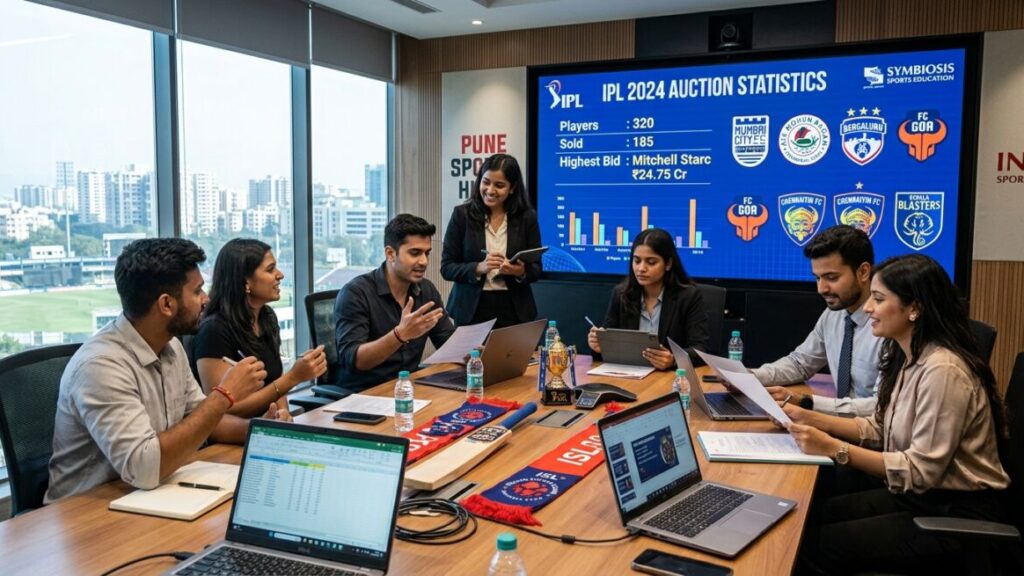
Ten years ago, telling your parents you wanted to work in sports meant one thing: play or go home. That has changed. Today, the Indian sports industry is valued at over ₹15,000 crore and is growing at 15% annually. From the high-pressure IPL auction room to managing Khelo India track events in Patiala, the demand for trained professionals is peaking.
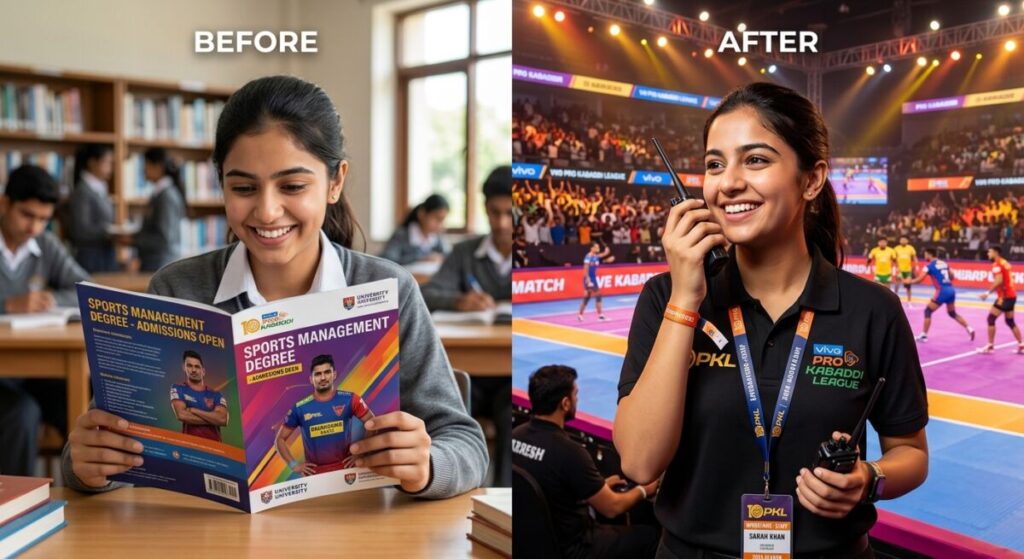
This guide walks you through the maze of sports management courses in India, the actual salary figures you can expect, and why choosing the right institute is the difference between a desk job and a dugout role. You will learn about degree levels, placement realities, and how to transition from a fan to a professional. The bottom line? The industry is no longer looking for fans; it is looking for managers.
Right now in Indian sport, the barrier to entry isn’t your ability to bowl a yorker. It’s your ability to manage a franchise budget, coordinate a broadcast team, or handle athlete logistics. But where do you start? Let’s get into it.
Why sports management courses in India are no longer a ‘Plan B’
For decades, sports was a hobby. In 2025, it is a high-stakes business. If you are still thinking about this as a ‘fallback’ option, you are already behind the curve. Why? Because the money has moved in.
The rise of the multi-league ecosystem in Indian sport
We used to have one cricket season. Now? We have a year-round calendar. The IPL started it, but the ISL (Indian Super League) and the PKL (Pro Kabaddi League) proved the model works for other sports too. Each of these leagues is a massive machine. And every machine needs operators.
Think about a single PKL match day. You have stadium operations, VIP hospitality, broadcast coordination, and anti-doping officials. None of these people are players. They are professionals who understood the sports management career scope early on. When you look at the 10 IPL franchises, you aren’t just looking at teams; you are looking at corporate entities that hire year-round. They need people who understand the Indian market, not just generic global theories.
Government initiatives: How SAI and Khelo India changed the game
It is not just about private leagues. The Government of India is now the biggest investor in grassroots sports. Between the Sports Authority of India (SAI) and the Khelo India scheme, hundreds of crores are being pumped into infrastructure. But infrastructure without management is a waste. This is why the demand for Khelo India coordinators and high-performance centre managers has shot up. They need people who can handle the logistics of 26 different sports across multiple cities simultaneously.
Choosing your level: Diploma, Bachelor’s, or MBA in sports management India
The biggest mistake students make is picking a course based on the name rather than the outcome. You need to align your education with your current stage in life. Are you a 12th pass student or a graduate looking to pivot?
Options for the 12th pass student: BBA and Foundation Diplomas
If you have just finished your HSC or SSC, you have the biggest advantage: time. A Bachelor in Sports Management or a BBA is your best bet. These programs don’t just teach you theory; they build your network while you are still young. In our 17 years of experience at ISST, we have seen that students who start right after their 12th board exams have a much stronger grasp of the Indian sports ecosystem by the time they graduate.
But what if you aren’t ready for a 3-year commitment? A foundation diploma in sports management after 12th can give you a taste of the industry. It’s a practical way to see if you actually like the business side of sports before diving into a full degree.
Post-graduate pathways: Specializing after your BCom or BBA
Are you stuck in a finance or marketing job you hate? You aren’t alone. Many of our highest-performing students are ‘Confused Graduates’ who realized late that their passion lies on the field. An MBA in sports management India or a Post Graduate Diploma is the bridge you need. You don’t need to start over from scratch. You just need to apply your existing business knowledge—accounting, marketing, HR—to the sports context. The truth is, an IPL team’s finance head still needs to know accounting. They just need to know it in the context of player auctions and salary caps.
Distance education: For active athletes and working professionals
We know the struggle of a state-level athlete. You are at the SAI-HPC in Patiala or training in Bengaluru, and you can’t attend a classroom in Pune every day. This is where distance education comes in. It is not ‘online learning’ in the sense of watching random videos. It is a structured pathway to ensure that when your playing days end, you have a career ready to go. Don’t wait until you retire to think about your second innings.
What do you actually study? The curriculum breakdown
Most people think sports management is just ‘hanging out with players.’ It isn’t. It’s hard work. It’s spreadsheets, legal contracts, and 14-hour match days. Here is what the actual curriculum looks like at a top-tier institute like ISST.
Sports Marketing: Selling more than just tickets
How does a brand like Tata or Dream11 decide to spend hundreds of crores on the IPL? You learn the math behind it. You study sponsorship activation, fan engagement, and digital rights. In India, sports marketing is the biggest slice of the pie. If you can prove ROI to a sponsor, you will never be out of a job.
Event & Venue Management: The logistics of a PKL match day
Have you ever wondered how an empty stadium becomes a high-octane broadcast venue in 48 hours? That is event management. You study crowd control, security protocols, vendor management, and hospitality. We often take our students to venues like the Balewadi Stadium in Pune to see this in action. It’s about managing the chaos behind the scenes so the fans see a seamless show.
Sports Law & Ethics: Understanding BCCI and international contracts
This is where things get serious. You study the legalities of player contracts, the WADA anti-doping code, and the governance structures of bodies like the BCCI or Hockey India. Understanding the fine print is what separates a professional from an amateur. If you want to work in an agent’s office or a federation, this knowledge is non-negotiable.
Let’s talk money: Sports management salary in India (The honest truth)
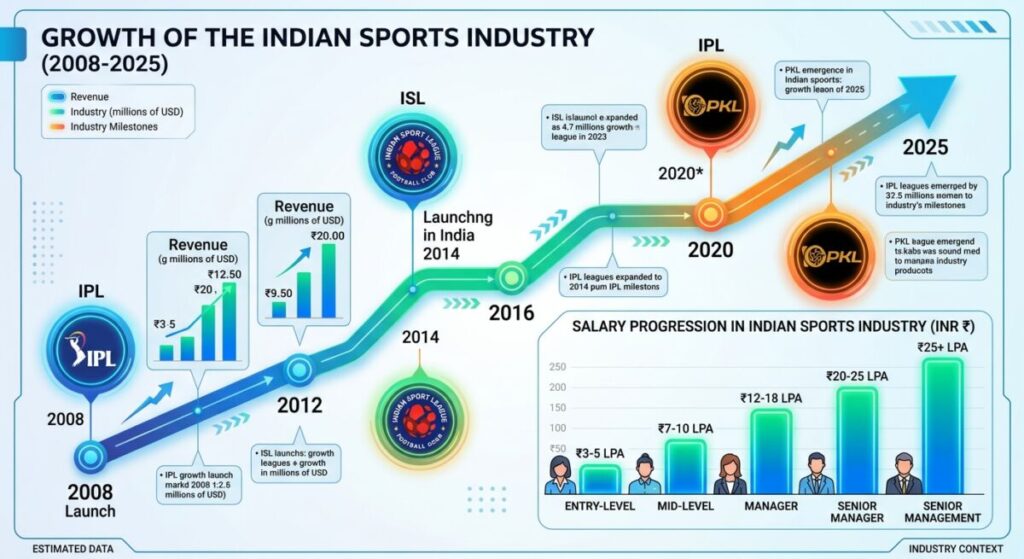
Let’s be honest. No one enters this field just for the ‘vibe.’ You want to know if it can sustain a life. The short answer is: yes, but you have to put in the time. The sports management salary in India varies wildly based on where you start.
Entry-level roles: What to expect in your first 24 months
A fresh graduate from a reputed institute typically starts at ₹3–5 LPA. This might be as an operations executive at a sports academy or a junior marketing associate for a sports tech startup. It’s a grind. You will work weekends. You will handle the small stuff. But you are building the network that pays off later.
Mid-to-Senior management: Reaching the ₹15–25 LPA bracket
After 5–7 years, once you have a few seasons of IPL or ISL on your CV, your value triples. Senior managers in franchise operations, sponsorship heads, or athlete managers for top cricketers easily hit the ₹15–25 LPA bracket. And if you reach the level of a CEO of a franchise or a high-ranking official in a national federation, the numbers go even higher. The ceiling is as high as the industry’s growth.
The Pune advantage: Why the city is a hub for sports management institutes
Why Pune? Why not Mumbai or Delhi? Here is the thing. Pune is the sports capital of Maharashtra for a reason. It is home to the Shree Shiv Chhatrapati Sports Complex, multiple national-level academies, and a culture that respects both education and athletics.
Choosing sports management institutes in Pune gives you a unique edge. You are close to the action without the overwhelming chaos of Mumbai, but close enough to commute for IPL internships or match-day assignments. At ISST, we have leveraged this location since 2008 to build 2,000+ alumni who now sit in some of the most influential rooms in Indian sport. We’ve won the CII Sports Business Award 2025 because we don’t just teach—we connect.
Frequently Asked Questions
What is the eligibility for sports management courses in India after 12th?
Most bachelor’s programs require you to have passed your 12th standard (HSC) from any stream with a minimum of 50%. Some institutes may have an entrance test or an interview to check your passion for the industry.
Which is the best institute for sports management in India?
The ‘best’ institute is one that offers a mix of UGC-recognized degrees and practical industry exposure. Look for a track record—ISST, for example, has been operating for 17 years and has placed students in nearly every major Indian sports league.
Is an MBA in sports management worth it in the Indian market?
Yes, especially if you want to enter mid-management roles. It gives you the business vocabulary needed to handle large-scale operations and budgets for franchises and sports brands.
What kind of jobs can I get after a sports management degree?
You can work as a Sports Operations Manager, Marketing Executive, Athlete Manager, Venue Coordinator, or even in Sports Analytics. The roles are as diverse as the industry itself.
Do I need to be a former athlete to study sports management?
Absolutely not. While being an athlete helps you understand the ‘on-field’ pain points, the industry desperately needs ‘off-field’ experts in finance, law, and marketing.
Can I get an internship in an IPL team?
Yes, most top-tier courses include a mandatory internship. Our students have frequently worked with franchises like Mumbai Indians and Chennai Super Kings during the auction and match seasons.
Are these degrees UGC-recognized?
Yes, degree programs offered through reputable institutes in collaboration with recognized universities are UGC-approved, making you eligible for further studies or government jobs.
How much does the course cost?
The fee structure varies by level. A diploma might cost less, while a full BBA or MBA is a larger investment. Most students recover their cost of the course within 24-36 months of working.
The bottom line
The sports industry in India is moving fast. Whether you are a 12th grader looking for a career that beats a 9-to-5 or a graduate tired of the finance grind, the pathways are now clear. You don’t need to be a Ranji player to work at the NCA; you need the right credentials and a network that gets you in the room.
We’ve been building those bridges since 2008. If you’re ready to stop watching from the stands and start managing the game, book a free counselling session with our experts today. No pressure. Just a conversation about where you want to be in the next five years.