Sports Science vs Physiotherapy: Which Career Path Should You Choose in 2026?
Imagine standing on the sidelines of a packed stadium during the 2026 IPL season. You see two professionals rushing toward a player. One is there to fix an acute ligament tear; the other has spent the last six months ensuring that player’s muscle fibers can handle the explosive force of a 150kmph delivery.
Most 12th-standard students in India confuse these two roles. That is a mistake. Choosing the wrong degree now could mean four years of studying the wrong thing. One path focuses on clinical rehabilitation. The other focuses on peak human performance. Both are essential. But they require different temperaments and skill sets.
This guide breaks down the core differences between sports science and physiotherapy, the real salary figures in the current Indian market, and which path matches your career goals. If you want to work in the high-stakes world of the Indian Super League (ISL) or the Sports Authority of India (SAI), you need to understand where you fit in the athlete’s value chain.
The Fundamental Divide: Sports Science vs Physiotherapy Explained
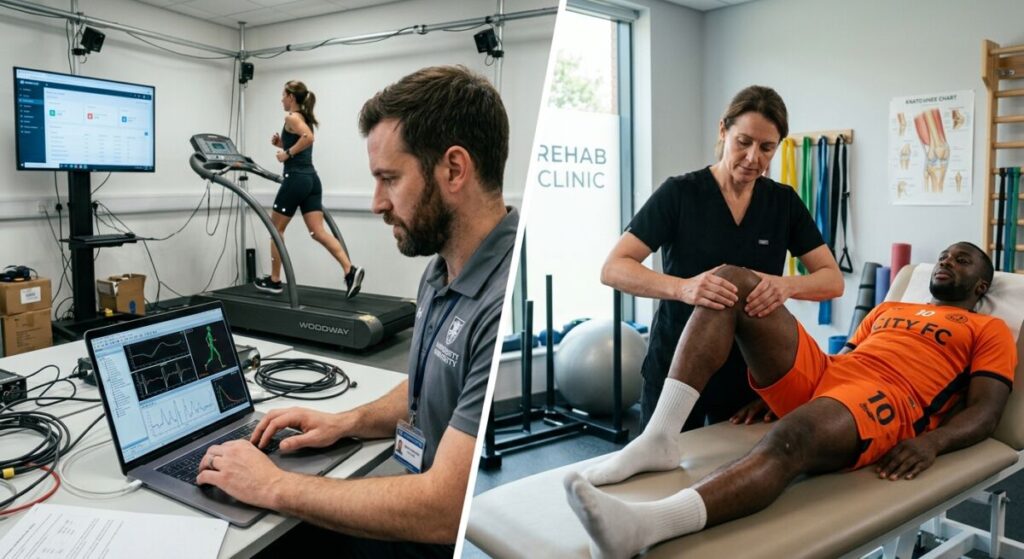
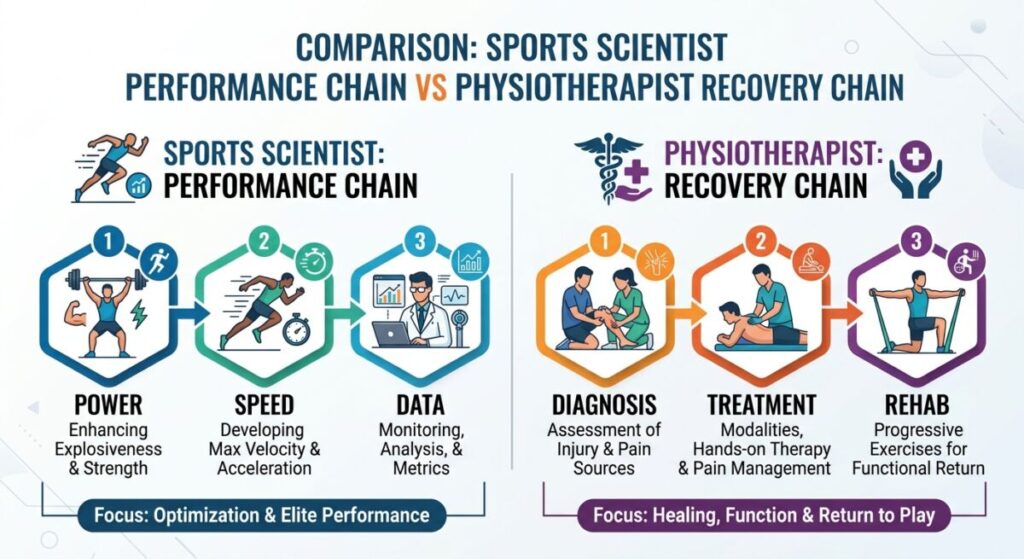
Let’s get one thing straight. A sports scientist is not a doctor for athletes. A physiotherapist is a medical professional. The divide is simple: recovery versus optimization.
What does a Sports Scientist actually do?
In our 17 years of experience at ISST, we have seen the role of the sports scientist evolve from a luxury to a necessity. In 2026, a sports scientist is essentially a data-driven performance architect. They look at the athlete as a machine that needs fine-tuning.
They use GPS tracking, heart rate variability (HRV) data, and biomechanical analysis to answer one question: How do we make this athlete 1% better today? They don’t just ‘train’ people. They manage workloads to prevent injuries before they happen. If you love numbers, physics, and the mechanics of movement, this is your field. You are the one telling the coach when a star bowler is at risk of a stress fracture based on their ‘acute-to-chronic’ workload ratio.
The Role of a Physiotherapist in Indian Sport
Physiotherapists are the healers. When a PKL (Pro Kabaddi League) raider twists an ankle, the physio is the first person on the mat. Their work is clinical. They diagnose injuries, create rehabilitation plans, and use manual therapy or dry needling to get players back on the field.
In the Indian context, a Bachelor of Physiotherapy (BPT) is a medical degree. You will study anatomy, pathology, and pharmacology. You are licensed to treat patients, not just athletes. While a sports scientist works on the ‘healthy’ athlete to make them ‘elite,’ the physio works on the ‘injured’ athlete to make them ‘functional’ again.
Physiotherapy vs Sports Science Salary: The 2026 Reality Check
Let’s talk money — because nobody else will give you straight numbers. The Indian sports industry is currently valued at over ₹15,000 crore, and salaries have shifted significantly since 2024.
Entry-Level LPA for BPT Graduates in India
If you finish your BPT and join a private hospital or a general clinic, expect a starting salary of ₹3–4.5 LPA. That is the baseline. However, if you specialize in sports physiotherapy and land a role with a state-level cricket academy or a mid-tier football club, that figure can jump to ₹6 LPA. The growth is steady but depends heavily on your clinical results. Most BPTs eventually open their own clinics, where the earning potential is limited only by their patient volume.
Earnings for Sports Scientists in IPL, ISL, and SAI-HPC
Here is the thing — the floor for sports science can be lower, but the ceiling is arguably higher in the franchise world. A fresh graduate with a BSc in Sports Science starting at a local gym might only see ₹2.5–3.5 LPA.
But the 2026 market for specialists is booming. According to our recent internal data, junior sports scientists in IPL dugouts or at a SAI-HPC (High Performance Centre) are now commanding ₹8–12 LPA. Senior performance directors at the national level or with top-tier franchises can easily cross ₹25–40 LPA. Why? Because teams have realized that losing a ₹15 crore player to a preventable hamstring injury is a massive financial disaster. They pay you to protect their investment.
Is Sports Science Better Than BPT for a Sports Career?
There is no ‘better’ degree. There is only a ‘better fit’ for your personality.
When BPT is the Right Choice (Clinical & Rehab Focus)
Choose BPT if you want job security outside of sports. If the sports industry hit a recession, a physiotherapist could still work in a neurology ward, a pediatrics clinic, or an ortho hospital. It is a versatile, licensed medical profession.
It is also the right choice if you enjoy the one-on-one process of healing. There is a deep satisfaction in helping an athlete walk again after an ACL surgery. But be prepared for the grind. The BPT course is 4.5 years long, including a mandatory internship. It is academically rigorous and requires a deep grasp of medical science.
Why Sports Science is Winning the Performance Market
If you find clinical environments boring, sports science is your lane. It is faster-paced. It is about the ‘gain,’ not just the ‘pain.’
In 2026, Indian sport is obsessed with the ‘high-performance’ model. From the TOPS (Target Olympic Podium Scheme) athletes in Patiala to the Mumbai Indians Academy, the demand is for people who understand sports technology. If you want to work with the latest Force Plates, Oxygen sensors, and AI-driven recovery tools, sports science is where the innovation is happening. It is a 3-year degree, meaning you enter the workforce faster than your BPT peers.
Sports Medicine Careers in India: Mapping the 2026 Landscape
Where will you actually work? The map is bigger than you think.
Roles in Private Franchises (IPL, PKL, WPL)
Franchises now hire entire ‘Performance Departments.’
– **Physiotherapists:** Manage the treatment room and match-day emergency response.
– **Sports Scientists:** Manage the gym, the GPS data, and the periodization of training.
– **Strength & Conditioning (S&C) Coaches:** Often a sub-specialty of sports science, focusing on raw power and speed.
Government Opportunities: Khelo India and TOPS Scheme
The Government of India is the largest employer of sports professionals in 2026. Through the Khelo India initiative, every district is looking for experts to man their centers of excellence. These are stable, respected roles with clear increments. Working at the National Sports University or an NSNIS facility gives you the chance to train the next Neeraj Chopra or P.V. Sindhu.
Academic Pathways: 12th Pass Eligibility and Course Duration
BSc Sports Science: Curriculum and Focus Areas
This is a 3-year undergraduate program. You will study exercise physiology, sports psychology, nutrition, and biomechanics. At ISST, our curriculum is designed to be practical. We don’t just teach theory; we show you how to use the equipment that teams actually use.
**Eligibility:** Usually 12th pass (Science is preferred, but some institutes allow other streams if you have a strong sports background). No NEET is required.
BPT (Bachelor of Physiotherapy): The Clinical Commitment
This is a 4.5-year commitment. You will spend a lot of time in hospitals, not stadiums, during your training. You will learn about every system in the human body, from the heart to the brain.
**Eligibility:** 12th pass with Physics, Chemistry, and Biology (PCB). Some states require a CET (Common Entrance Test), but NEET is generally not mandatory for BPT in most private institutes in India as of March 2026.
Frequently Asked Questions
Can a physiotherapist become a sports scientist?
Yes, many BPT graduates do a specialized Masters in Sports Science to bridge the gap between rehab and performance. It makes them highly employable because they can handle both ends of the athlete’s journey.
Is BPT compulsory for working with the Indian Cricket Team?
To be the ‘Head Physio’ of the BCCI, a BPT or equivalent medical degree is mandatory. However, the team also employs dedicated sports scientists and strength coaches who do not need a BPT.
What is the starting salary for a sports scientist in India in 2026?
A fresh graduate can expect ₹3–5 LPA in private academies, while those entering top-tier franchises can start closer to ₹8 LPA. Specific niche skills like biomechanical analysis can push this higher.
Which degree has more job security: BPT or BSc Sports Science?
BPT offers higher general job security because you can work in any hospital. BSc Sports Science offers higher ‘niche’ security within the rapidly expanding ₹15,000+ crore Indian sports industry.
Do I need NEET for sports science or physiotherapy courses?
As of 2026, NEET is not required for BSc Sports Science. For BPT, most private institutes and state universities use their own entrance exams or merit-based 12th-standard scores.
What is the ROI on a sports science degree compared to BPT?
BSc Sports Science has a faster ROI because the course is shorter (3 years) and the fees are generally lower. BPT takes longer to break even due to the 4.5-year duration and higher tuition costs.
Can I work abroad with an Indian sports science degree?
Yes, but you will often need a Master’s degree from a recognized institute like ISST and international certifications (like NSCA or ACSM) to be competitive in markets like Australia or the UK.
Which role travels more with the team?
Both roles travel extensively during the season. However, the physiotherapist is usually ‘on-call’ 24/7 during a tournament, whereas the sports scientist’s work is often concentrated around training sessions and data analysis.
The Bottom Line
The choice isn’t about which degree is ‘better’ — it’s about where you want to spend your working day.
If you love the clinical environment, the medical side of sport, and the satisfaction of rehabilitation, BPT is your path. But if you are obsessed with human performance, data, and making athletes faster and stronger, sports science is where the future of Indian sport lies.
In our 17 years of experience, we’ve seen students from both paths reach the top. What matters is starting with a foundation that the industry respects. The 2026 sports ecosystem in India is growing at 15% annually; there is room for both.
If you’re still undecided, book a counselling session with our experts at ISST to map your specific career path. Let’s find out where you belong in the dugout. Take the first step toward your career in sports today.