Sports Science Degree in India: The 2026 Guide to Careers, Colleges, and Salaries
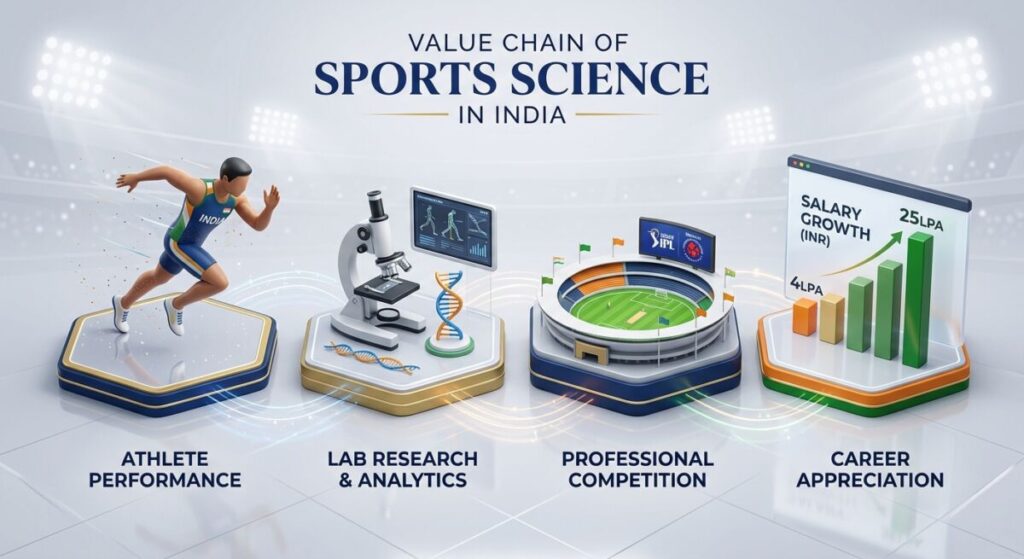
Your HSC exams are over. The pressure to choose between ‘stable’ engineering or medicine is hitting hard. But here is the thing — Indian sport is no longer just about the 11 players on the field. It is a sophisticated value chain where performance is engineered in a lab before it is delivered on the pitch.
By March 2026, India’s sports industry has crossed the ₹16,000 crore mark. This growth is not accidental. It is driven by a structural shift toward scientific preparation. If you understand the mechanics of the human body, you hold the keys to the most exclusive rooms in Indian sport: the IPL dugout, the SAI High-Performance Centre, and the national team locker room.
This guide breaks down the strategic positioning of a sports science degree India. We will look at the B.Sc. Sports Science syllabus, identify the colleges with the highest ROI, and talk straight about the ₹4–15 LPA salary reality. If you want to turn your passion into a professional competitive advantage, keep reading.
Why a sports science degree in India is the smartest move in 2026
The competitive forces in the Indian sports market have changed. In the past, teams relied on ‘gut feeling.’ Today, they rely on data. This shift has created a massive supply-side gap. There are simply not enough qualified sports scientists to fill the roles created by the expansion of our sporting ecosystem.
The post-Paris 2024 surge and Khelo India 2026 impact
India’s performance at the Paris 2024 Olympics was a turning point. It proved that talent alone is not enough; we need high-performance systems. Since then, the government has doubled down on the Khelo India Games initiative.
By early 2026, the Ministry of Youth Affairs and Sports has established over 50 dedicated sports science centres across the country. These centres need specialists in biomechanics, nutrition, and recovery. The demand is at an all-time high because the goal is now clear: a top-10 finish in the 2028 Olympics. You are not just getting a degree; you are entering a national priority sector.
From IPL dugouts to SAI High-Performance Centres (HPC)
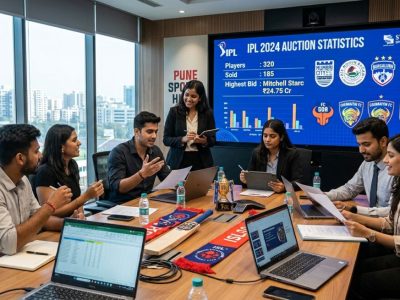
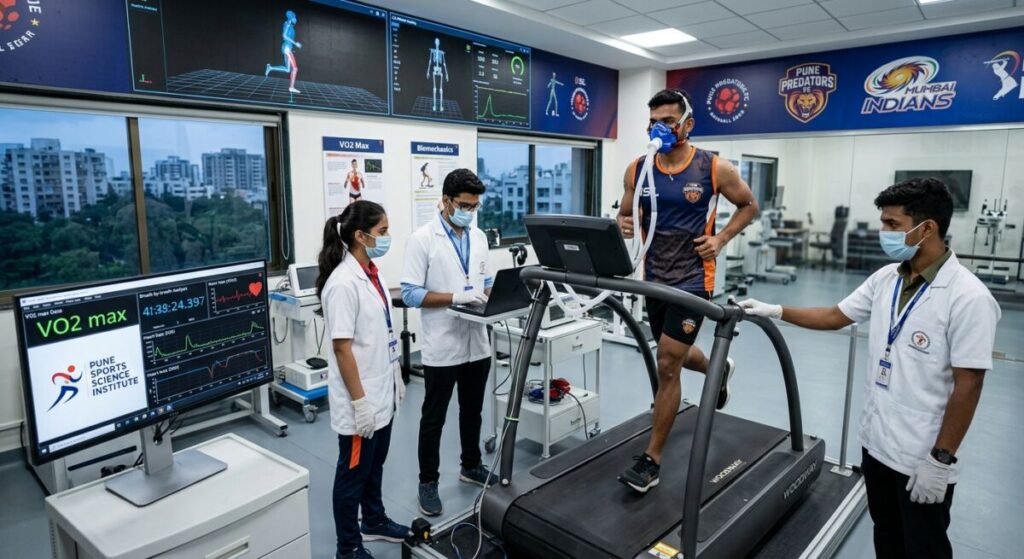
Think about the IPL. It is no longer just a two-month tournament. It is a year-round operation with global academies. Every franchise — from Mumbai Indians to RCB — now employs a full-time sports science wing. They use GPS tracking, force plates, and metabolic carts to monitor players.
The Sports Authority of India (SAI) has also undergone a massive digital and scientific overhaul. Their High-Performance Centres (HPC) in Patiala and Bengaluru are now hiring sports science graduates as Performance Analysts and Strength and Conditioning coaches. These are not just jobs; they are high-status career tracks that did not exist 10 years ago.
Top sports science colleges in India: Where to study
Choosing where to study is a strategic decision. You need a mix of academic rigor and industry access. In our 17 years at ISST, we have seen that the best outcomes come from institutes that bridge the gap between a classroom in Pune and the boundary rope at an ISL match.
Institutional breakdown: ISST Pune vs. Government Universities
Government universities like NSNIS Patiala or LNIPE Gwalior offer deep academic roots and low fees. They are excellent for those aiming for government sector roles or research. However, their placement cycles can be traditional.
On the other hand, specialized institutes like ISST focus on industry-led education. We are based in Pune, the high-performance hub of Maharashtra. Our focus is on the current market needs of 2026. When you study a B.Sc. in Sports Science with us, you are learning from practitioners who actually work in the IPL and ISL. We were honored with the CII Sports Business Award in 2025 because our curriculum evolves as fast as the industry does.
What to look for: UGC-recognized vs. Industry-led certifications
Do not get confused by labels. For a degree to hold weight in India, it should be UGC-recognized. This ensures your eligibility for government jobs and higher studies abroad. But a degree alone is not enough for the private sector. Look for institutes that offer additional certifications in specialized software like Catapult or Hudl. That is what makes your resume stand out in an auction room.
Scope of sports science in India 2026: Career pathways
What does a sports scientist actually do? It is not just one job. It is a spectrum of specializations. Most students go wrong by trying to be a ‘generalist.’ The 2026 market rewards specialists.
Performance Analyst: Using data to win matches
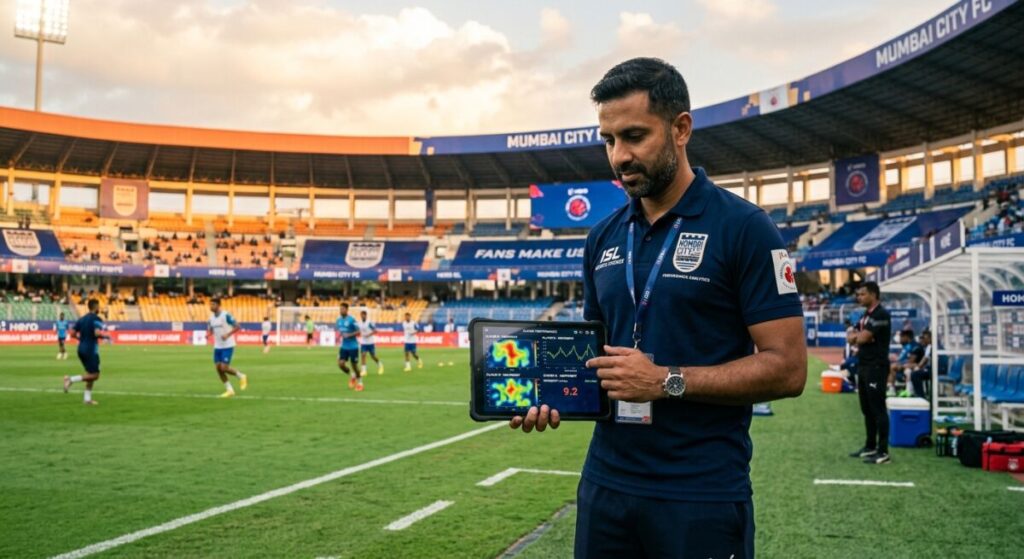
Analytic roles have exploded. As an analyst, you use video and wearable tech to break down every movement. Why did a fast bowler’s speed drop in the third spell? Why is a striker missing their target in the 80th minute? You provide the answer. Teams in the Pro Kabaddi League (PKL) now hire dedicated data analysts to strategize for the auction and the mat.
Sports Nutritionist: Fueling India’s next Olympic gold
Nutrition is the new ‘secret sauce.’ A sports nutritionist does not just hand out diet charts. They manage the biochemistry of an athlete. In 2026, we see a massive rise in private consulting. Top athletes like Neeraj Chopra or P.V. Sindhu have dedicated teams. Even at the grassroots level, parents are now willing to pay for expert advice to give their child an edge.
Strength and Conditioning (S&C) Coach: Building the modern athlete
The S&C coach is the architect of the athlete’s body. You are responsible for power, speed, and injury prevention. This is perhaps the most stable career path within sports science. Every academy, from a local cricket club to the National Cricket Academy (NCA), needs S&C experts. It is about converting raw talent into a ‘robust’ physical asset that can survive the 365-day sports calendar.
Understanding the B.Sc. Sports Science syllabus and eligibility
What will you actually study? The syllabus is a mix of hard science and practical application. If you hated biology in school, think again — this is biology with a scoreboard.
Core subjects usually include:
- Anatomy and Physiology: How the body is built and how it functions under stress.
- Biomechanics: The physics of movement. This is how you fix a bowling action or a sprint start.
- Sports Psychology: Managing the pressure of the final over.
- Kinesiology: The study of muscle movement and exercise mechanics.
Eligibility for most sports science degree India programs requires a 12th pass certificate. While a Science background (PCB/PCM) is preferred and often mandatory for B.Sc. tracks, some institutes allow Commerce or Arts students if they have a strong sports background. Always check the specific criteria for the 2026 intake, as many colleges are now conducting their own entrance exams or merit-based interviews.
Money Talk: Sports science salary in India 2026
Let’s get to the numbers. We will be upfront: you won’t earn IPL-level money on day one. But the growth curve is steeper than in almost any other field.
Starting salaries for fresh graduates (₹3–6 LPA):
If you start at a private gym, a local sports academy, or as a junior assistant in a SAI facility, expect a starting CTC of ₹25,000 to ₹45,000 per month. It is a period of ‘paying your dues’ and building a portfolio.
Earning potential in IPL, ISL, and PKL franchises (₹12–35 LPA):
Once you have 3-5 years of experience and a couple of successful seasons under your belt, the numbers jump. A head S&C coach or a Lead Performance Analyst for an IPL team can easily command ₹20 LPA or more. High-end private consultants who work with multiple pro-athletes often earn upwards of ₹35 LPA. The ceiling is genuinely high because your value is tied to the team’s success.
The Parent’s Corner: ROI and job security in sports education
We know the conversation at the dinner table. "Is this a real degree?" "Will you get a job in a bank if this fails?"
Here is the reality for 2026: Sports science is a specialized branch of healthcare and data science. Even if you choose to move out of professional sports later, your skills in physiology and data analysis are highly transferable to the multi-billion rupee wellness and corporate fitness industry.
Addressing the ‘stable job’ myth:
In 2026, job security comes from specialized skills, not generic degrees. With India bidding for the 2036 Olympics, the government’s investment in sports infrastructure is guaranteed for the next decade. This is as ‘stable’ as it gets.
Education loans and scholarships:
Most UGC-recognized sports science degrees are eligible for education loans from banks like SBI or HDFC. Additionally, many institutes, including ISST, offer merit-based scholarships for national and state-level players. Do not let the fee structure stop you; see it as an investment in a high-growth asset class.
Frequently Asked Questions
What is the eligibility for a B.Sc. in Sports Science in India?
Typically, you need to be a 12th pass student with a Science background (Physics, Chemistry, Biology). However, some institutes offer bridge courses for Commerce or Arts students with a strong athletic record.
Which are the best sports science colleges in India for placements?
ISST Pune, NSNIS Patiala, and LNIPE are top choices. ISST specifically leads in private sector placements within IPL and ISL franchises due to our industry-heavy network.
Can a Commerce student pursue a sports science degree in India?
Yes, but it depends on the university. Many modern sports institutes now look at ‘aptitude and interest’ alongside school subjects, though you might need to catch up on basic anatomy.
What is the average starting salary for a sports scientist in IPL?
Junior analysts or assistants in an IPL ecosystem usually start around ₹5–7 LPA. Senior roles with years of experience can exceed ₹25 LPA.
Is a sports science degree better than a Physical Education (B.P.Ed) degree?
They serve different goals. B.P.Ed is focused on teaching and school-level coaching, while Sports Science is a technical, lab-based degree focused on elite performance.
Do I need to be a professional athlete to study sports science?
No. While a love for sport helps, sports science is a technical field. You need an analytical mind and a passion for human biology more than a trophy cabinet.
What is the duration of a B.Sc. Sports Science course?
In India, it is a standard 3-year undergraduate degree program divided into six semesters.
Are there distance education options for sports science?
Yes, for working professionals or active athletes, distance education programs are available, though they often require practical contact sessions.
The bottom line is that the sports science field in India has moved past its ’emerging’ phase — it is now a core pillar of the national sports strategy. Whether you are a 12th grader looking for your first degree or an ex-athlete looking to transition, the 2026 market offers more diversity than ever.
Don’t wait for the next auction cycle to realize you missed the bus. The structural growth of Indian sport is happening right now. If you are ready to turn your passion for the game into a high-paying professional career, book a free counselling session with our experts today and let’s map out your path into the Indian sports ecosystem.