Are You Training for the Right Sport?
You want to compete at the national level. You want the scholarship. You want the glory. But here is the hard truth: if your sport isn’t on the official list, you are running a race that doesn’t exist.
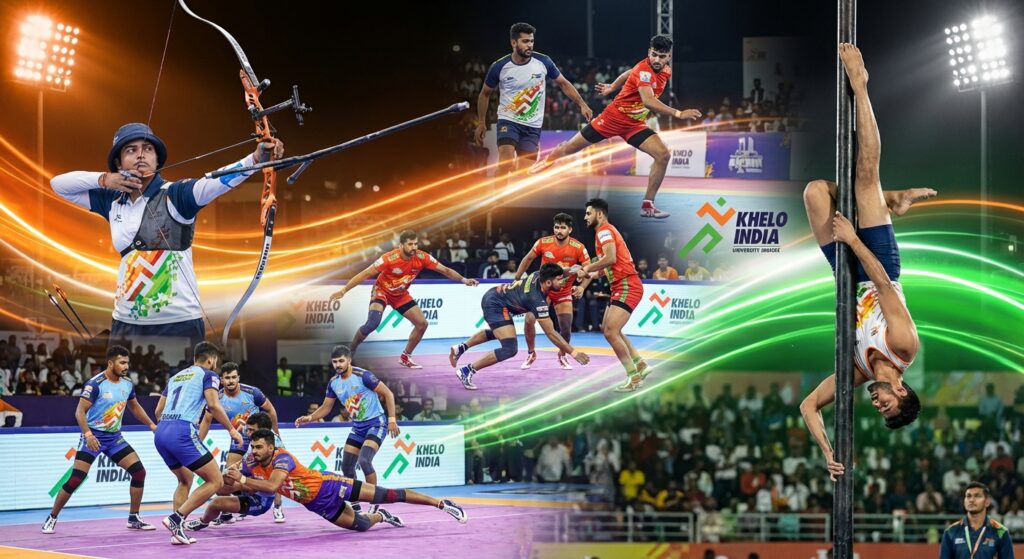
The Khelo India University Games (KIUG) have become the single biggest platform for university-level athletes in India. It is not just a competition. It is a talent hunt. The government is watching. Scouts are watching. And the stakes? A ticket to the Target Olympic Podium Scheme (TOPS).
In our work at the Institute of Sports Sciences & Technology (ISST), we see thousands of students confused about which disciplines actually qualify for funding. They train for years only to realize their specific category isn’t included in the University edition of the games.
Don’t make that mistake.
Below is the definitive, no-nonsense list of sports included in the Khelo India University Games. We will also break down the strategy behind why these sports were chosen and how you can capitalize on them.
For a complete breakdown of how to get into the system, read our comprehensive pillar guide: Khelo India Games: The Ultimate Guide to Eligibility, Scholarships & Careers (2026).
The Official Sports List: What’s In?
The Ministry of Youth Affairs and Sports doesn’t pick these randomly. They focus on disciplines with high medal potential at the Olympics and Asian Games. If you are playing one of these, you are in the priority lane.
Here is the core list generally seen across recent editions of the Khelo India University Games:
- Archery (Recurve & Compound)
- Athletics (Track & Field events)
- Badminton
- Basketball
- Boxing
- Fencing
- Football
- Hockey
- Judo
- Kabaddi
- Rugby
- Swimming
- Table Tennis
- Tennis
- Volleyball
- Weightlifting
- Wrestling
- Shooting
- Rowing
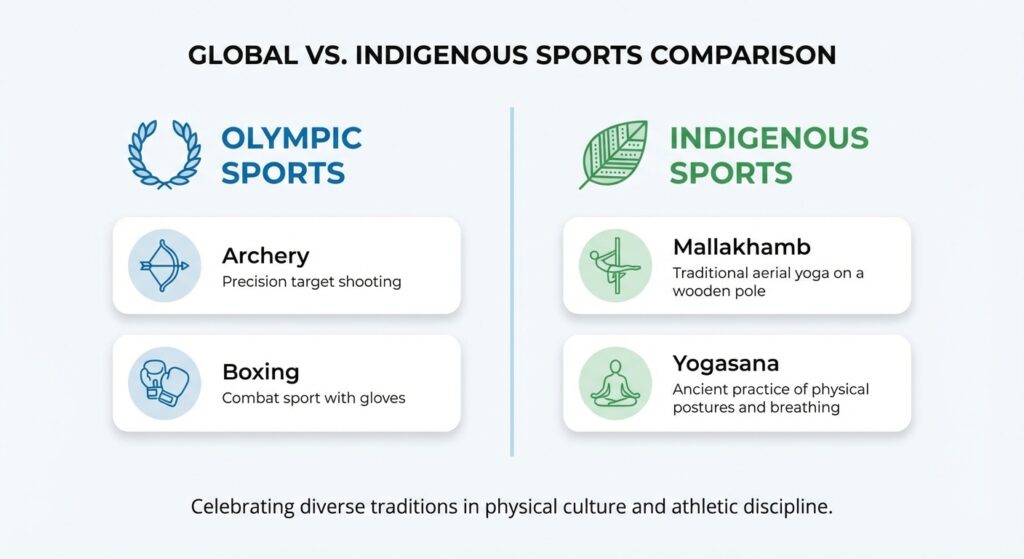
Notice something? These are high-performance Olympic sports. But that’s not the whole story.
The Indigenous Revolution: Traditional Sports Go Mainstream
This is where it gets interesting. A few years ago, the government made a bold move. They decided that Indian sports shouldn’t just be about cricket or football. They wanted to revive our heritage.
So, they added indigenous sports to the roster. This was a game-changer.
The Indigenous Additions:
- Mallakhamb: The ancient art of pole gymnastics.
- Yogasana: Competitive yoga (yes, it is a sport now).
- Gatka: Traditional martial art from Punjab.
- Kalaripayattu: The oldest martial art form from Kerala.
- Thang-Ta: Manipuri martial art.
Why does this matter to you? Because competition in these sports is currently lower than in cricket or badminton. The pathway to a national medal—and the scholarship that comes with it—might be faster here if you have the aptitude.
Curious about the age limits for these specific traditional sports? Check out our detailed analysis on Khelo India Games Age Limit & Eligibility Criteria (2026 Rules).
Individual vs. Team Sports: Where Should You Focus?
Here is a data point most people ignore. In team sports like Football or Kabaddi, your university team needs to qualify. You are dependent on 10 or more other people performing at their peak. One weak link, and you go home.
In individual sports like Shooting, Archery, or Wrestling, your destiny is in your own hands. The selection criteria for KIUG often pulls the top 8 or top 16 athletes from the All India Inter-University Games.
If you are an individual athlete, your route is direct. Win at the inter-university level, and you are in. For team sports, the zonal qualification process is brutal. You need to be aware of the difference before you commit your season to a specific discipline.
Want to know how this affects registration? We have a guide for that. See How to Register for Khelo India Youth Games Online (2026 Guide)—the process is very similar for university athletes.
Why Is Your Sport Missing?
Did you scan the list and not see Cricket? Or Powerlifting? Or Chess?
That is frustrating. I get it. The KIUG roster is heavily influenced by the Olympic charter. Since Cricket is only just re-entering the Olympics (Los Angeles 2028), it hasn’t been a staple of the Khelo India ecosystem yet. However, with the inclusion of T20 in the Olympics, we expect this to change rapidly in the next cycle.
Also, the host state matters. When a state hosts the games, they often lobby to include sports popular in their region. For example, when the games move to the North East, martial arts get a heavier focus. When in the South, water sports might get a boost.
You need to stay updated. The list evolves every single year.
The Financial Angle: It’s Not Just About Medals
Why do we stress about this list so much at ISST? Because being on this list equals money. Scholarships.
Athletes identified through these games receive an annual scholarship of ₹6.28 lakhs. That covers your training, diet, and equipment. If your sport isn’t on the list, you aren’t eligible for this specific central government funding.
But what if you aren’t an athlete? What if you love sports but can’t run a sub-11-second 100 meters?
You can still be part of the Khelo India ecosystem. These games require thousands of managers, bio-bubble coordinators, and technical officials. The industry is booming, and salaries are rising.
If you want to understand the business side of these games, look at our breakdown of The Truth About Sports Management Salaries in India (2025 Data) or consider how a Bachelor in Sports Management can get you into the stadium without breaking a sweat.
What If Your Sport Is Dropped?
It happens. Sports get rotated out. If you are a university athlete, you need a backup plan. Diversify your skills. Many athletes in Athletics also train for Rugby (which requires similar speed and explosive power).
Don’t be one-dimensional. The modern athlete is adaptable.
Also, consider the support roles. Sports Science is massive right now. Athletes need recovery experts. You could be the one keeping them in the game. Read about Training for Gold with Cutting-Edge Sports Science to see where the industry is heading.
FAQs: Your Questions Answered
1. Is Cricket included in the Khelo India University Games?
Generally, no. While Cricket is popular, KIUG focuses on Olympic and indigenous sports. However, with Cricket’s inclusion in the 2028 Olympics, this may change soon.
2. Can I participate in two sports?
Technically, yes, if the schedules don’t clash. However, the high level of competition usually requires you to specialize in one discipline to qualify.
3. Are the rules for University Games different from Youth Games?
Yes. The age criteria differ (usually under 25 for University Games), and participants must be enrolled in a university. See our eligibility guide for details.
4. Is Mallakhamb only for athletes from Maharashtra?
No. While it originated there, athletes from any university across India can compete in Mallakhamb if they qualify through their zonal inter-university tournaments.
5. How do I register for these sports?
Registration is done through your university’s director of sports, who submits entries to the Association of Indian Universities (AIU). You cannot register individually.
6. What happens if I win a Gold medal?
Winners are often shortlisted for the Khelo India scholarship scheme and may be invited to National Camps for Asian Games or Olympic selection.
7. Are water sports like Rowing included?
Yes, Rowing and Swimming are staples of the games, though the specific events may vary based on the host city’s infrastructure.
8. Is there a bio-bubble for athletes?
In recent years, strict health protocols have been used. To understand how this works, read What is a Bio Bubble? The Sports Pro’s Guide.
Stop Waiting. Start Preparing.
Knowing the list is just step one. Now you need to execute. Whether you are an athlete aiming for the podium or a future manager aiming to organize the next big event, the sports industry in India is exploding.
At ISST, we don’t just watch the games; we build the professionals who run them. If you are serious about a career in sports—on the field or in the front office—you need the right education.
Ready to turn your passion into a paycheck? Explore our Sports Management Courses in Mumbai and Pune today.