Is a career in sports just about passion, or can it actually pay the bills?
For years, the Indian sports industry was viewed as a niche hobby rather than a viable career path. But look around you. The Indian Premier League (IPL) is now the second most valuable sports league in the world. Leagues like the ISL (Football) and PKL (Kabaddi) are thriving. Grassroots academies are professionalizing.
The narrative has shifted. The question is no longer if there are jobs, but rather: How much do they pay?
If you are considering a career shift or are a student planning your future, you need hard numbers, not just hype. In this guide, we reveal the unfiltered truth about Sports Management Salaries in India, utilizing 2025 market projections to help you make an informed decision.
The Landscape: What Influences Pay in Sports?
Before we look at the numbers, it is crucial to understand that not all sports jobs are created equal. A Sports Management Salary in India fluctuates significantly based on three key pillars:
- The League Ecosystem: Working for a top-tier franchise (like Mumbai Indians or Bengaluru FC) pays significantly more than working for a regional association or a local academy.
- Specialized Skills: Generalists are paid average salaries. Specialists—those with skills in data analytics, digital sponsorship, or athlete reputation management—command a premium.
- Location: Opportunities in sports hubs like Mumbai, Bangalore, and Delhi generally offer higher packages to match the cost of living and the density of sporting organizations.
Explore ISST’s Specialized Masters in Sports Management Programs
Sports Management Salaries in India: 2025 Role Breakdown
Let’s get straight to the data. We have analyzed current market trends to provide a realistic range of what professionals are earning in the Indian sports sector this year.
Please note: These figures represent annual packages (CTC) and can vary based on individual negotiation skills and prior experience.
| Job Role | Experience Level | Estimated Salary Range (INR) |
| Sports Operations Manager | Mid-Level (3-5 Years) | ₹6,00,000 – ₹10,00,000 |
| Digital Marketing Manager | Mid-Level | ₹5,00,000 – ₹8,00,000 |
| Sports Data Analyst | Entry/Mid | ₹4,50,000 – ₹7,50,000 |
| Video Analyst | Entry-Level | ₹3,00,000 – ₹5,00,000 |
| Sponsorship Sales Manager | Mid/Senior | ₹7,00,000 – ₹15,00,000+ |
| Venue Manager | Mid-Level | ₹5,00,000 – ₹9,00,000 |
| Athlete Manager (Agent) | Senior | Commission-based (High Cap) |
| Grassroots Development Officer | Entry-Level | ₹3,00,000 – ₹4,50,000 |
As you can see, revenue-generating roles (like Sales and Sponsorship) often have higher ceilings due to commissions, while technical roles (Analysts) are seeing the fastest growth in base pay.
The “Glamour” Factor: Jobs in IPL Salary Revealed
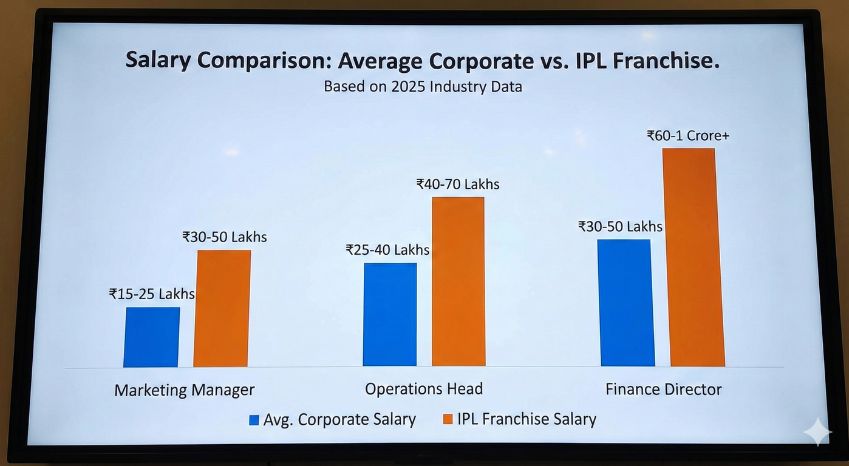
The Indian Premier League is the holy grail for many aspiring sports managers. Consequently, Jobs in IPL salary brackets are often the most searched metrics in the industry.
Working for an IPL franchise is intense. It involves high pressure, travel, and 24/7 availability during the season. However, the financial rewards are competitive.
- Entry-Level Logistics/Hospitality: While seasonal interns might earn a stipend, full-time junior logistics coordinators can expect between ₹4-6 Lakhs per annum.
- Team Managers: This is a high-trust role involving handling star players. Salaries often range from ₹12-18 Lakhs per annum for experienced professionals.
- Social Media Heads: With fan engagement being a primary revenue driver, franchise digital leads can command upwards of ₹10-15 Lakhs per annum.
Pro Tip: Many IPL jobs start as seasonal contracts. Converting these into permanent, year-round positions requires exceptional performance and formal education in sports management.
Sports Manager Starting Salary: What Freshers Can Expect
If you are just graduating, you need to manage your expectations. You likely won’t start as the General Manager of a cricket team.
The average Sports Manager starting salary in India for a fresher generally falls between ₹3,00,000 and ₹4,50,000 per annum.
While this might seem modest compared to IT or Investment Banking starting packages, the growth trajectory in sports is much sharper. A professional who starts at ₹4 Lakhs can easily double their salary within 3 years by moving from a local academy to a national league or by proving their worth in sponsorship acquisition.
The key is to view your first job as a paid apprenticeship. You are being paid to build your network.
How to Increase Your Starting Salary?
This is the most important section of this article. How do you move from the lower end of the salary bracket to the higher end? How do you ensure you are the candidate offered ₹5 LPA instead of ₹3 LPA?
The answer lies in Practical Application.
Employers in the sports industry value “street smarts” and operational experience over pure theory. They want to know if you can handle a crisis at a stadium gate or manage a sponsor’s sudden demands.
The ISST Advantage: Internships & Networking
At the Institute of Sports Science and Technology (ISST), we recognized early on that a degree alone isn’t enough to maximize your Sports Management Salary in India.
This is why our curriculum is engineered around industry immersion.
- Live Internships: ISST provides students with internship opportunities at major sporting events, leagues, and associations. When you walk into an interview with experience working at a Pune Marathon or an ISL match, your negotiation power increases instantly.
- Networking: We connect you with alumni who are already working in top positions. In sports, who you know matters as much as what you know.
- Specialized Certification: ISST doesn’t just teach “management.” We dive into sports sciences, nutrition basics, and analytics, making you a multi-faceted asset to any organization.
Candidates with valid internship certificates and portfolio work from ISST are statistically more likely to secure higher starting packages than peers with generic management degrees.
The Future of Sports Careers in India
The industry is currently growing at a Compound Annual Growth Rate (CAGR) that outpaces many traditional sectors. With the government’s push for the Olympics and the private sector’s investment in leagues for Kho-Kho, Volleyball, and Table Tennis, the demand for qualified managers is skyrocketing.
By 2026, the gap between the demand for skilled sports managers and the supply of qualified talent is expected to widen. This is good news for you. High demand and low supply inevitably lead to higher salaries.
Conclusion
The data for 2025 is clear: A career in sports management is no longer a gamble—it is a strategic career move.
Whether you are eyeing high-paying Jobs in IPL salary brackets or looking to build a stable career in operations, the potential is vast. However, securing the best Sports Management Salaries in India requires more than just enthusiasm. It requires the right education, the right network, and the right launchpad.
Are you ready to turn your passion into a high-paying profession?
Take the Next Step
Don’t guess your future value—plan it. We have compiled a detailed report on career trajectories, emerging roles, and salary predictions for the next 5 years.
Download our 2025 Sports Career & Salary Report